
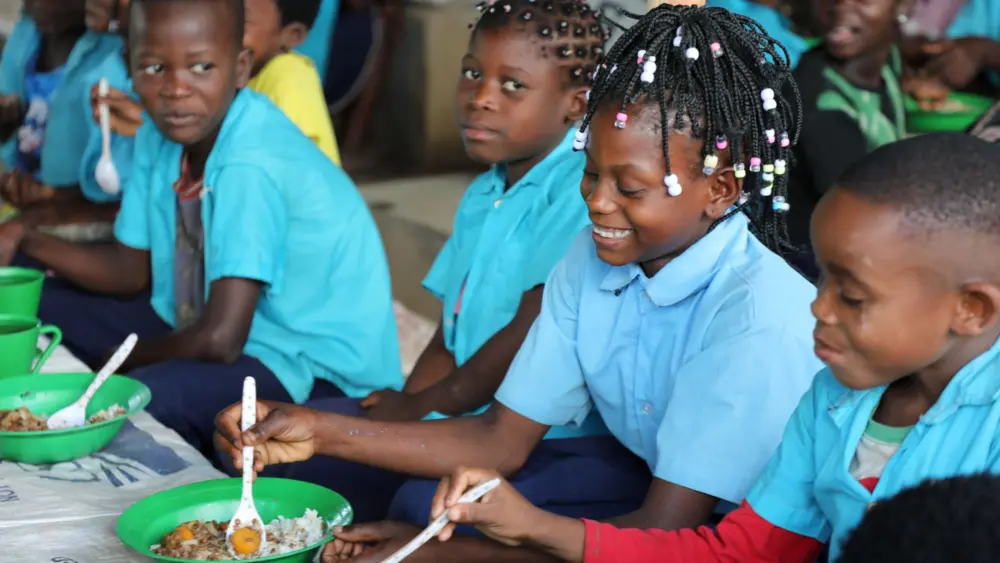
Building sustainable school meal systems that nourish children and strengthen communities
The 2026 Global Child Nutrition Forum brings together government leaders, technical experts, practitioners, researchers, and partners working to strengthen school meal programs around the world. Hosted by the Global Child Nutrition Foundation in partnership with the Government of the Republic of Zambia, the Forum will include plenary discussions, technical workshops, school visits, and opportunities for countries and partners to share practical learning. This year’s theme is From Vision to Action: Achieving Ambitious School Meal Program Objectives.
World Vision is participating as a Systems Change Agent sponsor, sharing evidence and program experience on how school meals can support children’s nutrition and education while strengthening local markets, community ownership, and national systems. Our participation will include technical workshops, a research poster, and a multi-day exhibit featuring school feeding programs and resources.
More than a meal
School meals can do far more than address children’s immediate hunger. When programs are connected to community priorities and local food systems, they can help create dependable markets for farmers and small businesses, support children’s nutrition and learning, and strengthen the institutions responsible for delivering essential services.
World Vision works with governments, communities, donors, researchers, and implementing partners to move from providing meals to building school feeding systems that are locally owned, financially sustainable, and responsive to different country contexts. This work combines evidence-informed program design, large-scale implementation, local systems strengthening, and continuous learning.
Join World Vision’s technical workshops
World Vision is leading three technical workshops focused on inclusive economic opportunities, community engagement, and school meals in crisis and displacement settings.
Feeding Children, Fueling Economies: Leveraging School Meals to Drive Local Jobs, Markets, and Inclusive Growth
Tuesday, November 3 | 10:00 a.m.–12:00 p.m. | Breakout Room AG09 | Spanish and Portuguese interpretation available.
How can school meal programs create opportunities that extend far beyond the classroom? This session will explore how local and regional food procurement, supported by strong government leadership and policy, can strengthen food systems, expand market access, and generate economic opportunities for farmers, small businesses, and communities. Drawing on experiences from Angola, Mozambique, Zambia, and other contexts, speakers from World Vision and partner organizations will share lessons on how school feeding investments can support nutrition and education outcomes while fueling inclusive economic growth.
Presenters
- Precious Mubanga, Senior Manager, Food Security and Livelihoods, World Vision U.S.
- Richard Ndou, Chief of Party, PARES, World Vision Mozambique
- Robert Bulten, Chief of Party, ANGEL, World Vision Angola
- Mazuba Ignatius Mwiinga, Head of Growth and Communications, Mary’s Meals International
Designing Community Engagement in School Feeding: Pathways to Equity, Ownership, Quality, and Sustainability
Tuesday, November 3 | 3:00–5:00 p.m. | Banquet Hall 1 | English only.
How can school feeding programs harness community engagement while promoting equity and long-term sustainability? This interactive session will explore practical approaches for strengthening local ownership, improving program quality, and supporting lasting impact through community participation. Drawing on experiences from Malawi, Mozambique, Zambia, and other contexts, speakers from World Vision, Mary’s Meals, SNV, and the Government of Malawi will share lessons learned and strategies for designing more effective and sustainable school feeding programs.
Presenters
- Lopes Vieira Muquera, Deputy Chief of Party, PARES, World Vision Mozambique
- Monique Beun, Global Food Security and Nutrition Advisor, SNV
- Angela Chipeta-Khonje, Country Director, Mary’s Meals Malawi
Delivering More Nutrition for Less: Cost-Effective School Meal Models in Fragile and Displacement Settings
This workshop is offered twice:
- Monday, November 2 | 3:30–5:30 p.m. | Breakout Room AG08 | Arabic and Russian interpretation available.
- Tuesday, November 3 | 3:00–5:00 p.m. | Breakout Room AG02 | English only.
How can school meal programs maximize nutritional impact in contexts shaped by crisis, displacement, and limited resources? This session will examine practical approaches for designing cost-effective school feeding models that improve nutrition, strengthen local food systems, and support long-term sustainability. Through evidence, country experiences, and interactive discussion, participants will explore how governments and partners can balance nutrition, affordability, coverage, and operational realities in fragile settings. Speakers from World Vision, CARE, and government partners will share lessons from programs in Angola, Malawi, Mozambique, Somalia, and other contexts.
Presenters
- Kathryn Reider, Senior Nutrition Technical Advisor, World Vision U.S.
- Dr. Lotte Renault, Director, Program Quality, Education and Skills, CARE
- Tara Geiger, Food Security and Resilience Technical Advisor, CARE
Visit World Vision at the exhibit in the foyer
Stop by our exhibit in the event center foyer to meet members of the World Vision team and explore resources, research, and learning from our work in school feeding, nutrition, and food systems.
Research featured at the Forum
Are Low-Income Households Conditionally Cooperative? Contrasting Evidence from a Field Adapted Contributions Game: This study looks at how low-income households in Mozambique adjust their willingness to contribute money and volunteer time to a school meals program based on others’ participation. It found that many households donate less the more others donate, which suggests that telling people others are contributing may not always boost participation. Authors: James Allen IV, Naureen Karachiwalla, and Deboleena Rakshit, 2026
Poster presentation: Monday, November 2 | 5:30 p.m. | Foyer (Welcome Reception) Related resource: Who Gives When Others Give? Community Contributions to School Meals in Mozambique
Explore World Vision’s nutrition and school meals evidence and learning
Mozambique
- From ECT III to PARES: Lessons in Sustainability and Community Ownership in School Feeding in Mozambique
- PARES school feeding video
- PARES Project Factsheet
- Impact of Educating Children Together – Phase 3 (ECT3) in Mozambique
- Who Gives When Others Give? Community Contributions to School Meals in Mozambique
Angola
- ANGEL Program Fact Sheet
- Assessing the Feasibility of Local and Regional Procurement (LRP) for School Feeding under the ANGEL Program in Angola
- Socio-Cultural, Economic, and Environmental Determinants of Child Malnutrition in Angola
Ethiopia
- SPIR II’s Impact in Ethiopia: Restoring Hope, Building Resilience
- Nurturing Care Groups (NCGs): A SPIR II Nutrition Intervention Model
- Community-Based Participatory Nutrition Promotion (CPNP): A SPIR II Core Nutrition Intervention Model
- Family MUAC: A SPIR II Core Nutrition Intervention Model
School meals case studies
- Beyond the plate: How locally sourced school meals are creating economic opportunities in Burundi
- A daily meal, a stronger chance to learn: School meals supporting children’s education, nutrition, and well-being in La Gonâve, Haiti
- Child-led school feeding becomes a lifeline: Sustaining learning, nutrition, and well-being through conflict in Lebanon
- When school meals put communities in the driving seat: A cash-based school meals pilot in Myanmar
School meals policy and advocacy
- School meals in our words: Choosing our future
- School Meals Overview: The power of universal, inclusive and sustainable school meals
- Outcomes Report: 2nd School Meals Coalition Global Summit
Across contexts
- School meals as a community platform: Communities power sustainable solutions
- School meals as nutrition that fuels potential
- Fueling learning: How school meals improve education outcomes
- School meals: What makes a lasting impact?
Explore more of World Vision’s food security and nutrition work
