

Continuing our School Meals Day series, this blog expands the lens beyond the classroom to examine how school meals function as a community platform connecting families, markets, and public systems.
Schools are more than places of learning. In many settings, they are one of the few public institutions that consistently reach children, families, and communities. When school meals are intentionally designed, they can serve as a powerful platform linking education systems with local food markets, health services, and community accountability structures.
By Gabrielle Benjamin, Business Development Manager, Food Security & Livelihoods, World Vision
School meal programs are at a pivotal moment. Globally, governments provide meals to more than 400 million children, making school feeding one of the largest child-focused social safety nets in the world.1 Yet an estimated 73 million of the world’s poorest primary school-aged children attend school hungry.2 At the same time, rising food prices, climate shocks, conflict, and fiscal pressures are straining household incomes and national budgets.
In this context, school meals must function as more than feeding programs. Schools are one of the few public institutions that consistently reach children, families, and communities. When designed intentionally, school feeding serves as a community platform that connects education systems, local food markets, health services, and public accountability. In today’s policy and funding environment, where governments and donors prioritize human capital, resilience, localization, and systems strengthening, school meals are uniquely positioned to deliver on multiple returns.
What evidence shows
Evidence consistently shows that school feeding improves enrollment, attendance, and retention, particularly for vulnerable children and girls, by reducing household costs and incentivizing participation.3 Programs are linked to improved attentiveness and reduced absenteeism, especially when integrated with school health, hygiene, and water interventions.
Beyond education and nutrition, home-grown school feeding models that source food locally from smallholder farmers stimulate rural economies and deepen community ownership.4
National programs increasingly connect education, agriculture, nutrition, and social protection under unified frameworks. Cost–benefit analyses estimate that school meal programs generate between $3 and $10 in returns for every $1 invested through improved health, education, and productivity outcomes.5 School meals are therefore investments in human capital and economic resilience.
Taken together, this evidence indicates that school feeding delivers the greatest impact when ministries align across education, agriculture, health, and social protection; when food is sourced locally to strengthen market resilience; and when programs are financed as long-term human capital investments rather than short-term expenditures. Under these conditions, school meals rank among the most cost-effective public investments, even in fiscally constrained environments.
What This Looks Like in Practice
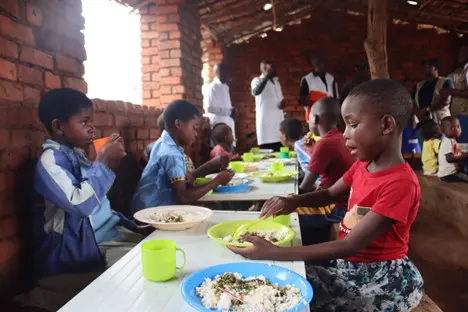
In Angola, the McGovern-Dole International Food for Education and Child Nutrition Program of the U.S. Department of Agriculture (USDA)-funded Angola Nutrition for Growth, Education and Learning (ANGEL) program illustrates how school feeding anchors multi-sector development. Implemented in partnership with the Ministry of Education and provincial governments, the five-year initiative integrates school meals with literacy promotion, health education, and infrastructure strengthening across 82 schools, targeting more than 80,000 participants.
The program rehabilitates kitchens and water systems, trains community volunteers and parent associations to support oversight, accountability, and sustainability, and works with schools and communities to strengthen local food procurement to support long-term sustainability. Implemented alongside government partners, the approach reinforces national standards and pathways for long-term scale.
Similarly, in Mozambique, the Partnering for Sustainable Education Outcomes (PARES) project demonstrates how feeding programs reinforces national systems. Implemented in 157 schools in collaboration with the Government of Mozambique and civil society partners, PARES has delivered more than 4.2 million meals while strengthening connections with 74 farmer groups to build local supply, and expand access to safe water through borehole construction. The project also supports deworming campaigns, literacy initiatives, and participation in Mozambique’s government-led School Meals Taskforce, advancing the National School Feeding Strategy through coordinated policy alignment and national ownership.
These examples show how schools serve as hubs connecting families, farmers, communities, and governments through structured procurement, accountability, and governance systems.
World Vision’s approach and technical expertise
World Vision’s comparative advantage lies in our long-term community presence and cross-sector expertise in education, nutrition, agriculture, livelihoods, and WASH. Rather than implementing feeding as a standalone activity, programs integrate literacy support, health services, local procurement, and systems strengthening at district and national levels. By building farmer capacity, reinforcing community oversight structures, and partnering with governments on policy and financing, World Vision supports the transition of school feeding into nationally owned, sustainable systems that function as scalable public infrastructure aligned with national priorities.
The return on investment and impact
Integrated school feeding aligns closely with priorities around localization, resilience, and human capital development. By leveraging existing school infrastructure, programs with local procurement focuses strengthen local markets through procurement and supply chain linkages. As a result, school meals deliver multi-sector returns: improved learning outcomes, greater income stability for smallholder farmers, and reinforced national systems.6, 7
Because school meal programs are anchored in national education systems that reach children at scale and have the potential to strengthen local supply chains, their sustainability depends on strong national leadership and financing. When properly supported and financed, they improve educational outcomes while reinforcing cost-efficiency and resilience to supply and price shocks. In this context, school meals remain among the most cost-effective investments in children and communities.
Communities power sustainable school meal solutions. Parents strengthen accountability, farmers supply nourishment, local leaders sustain political will, and governments provide scale. When aligned, school meals become foundational elements of resilient education systems and inclusive local economies. Experiences in Angola and Mozambique demonstrate that school feeding anchor literacy gains, strengthen health systems, expands water access, and reinforces national strategies. School meals are community-driven platforms that power human capital, strengthen food systems, and build more resilient futures.
Next up: the big question. What makes school meal programs last at scale?
Sources
1 World Food Programme. (2024). State of school feeding worldwide 2024. Rome: World Food Programme. https://www.wfp.org/publications/state-school-feeding-worldwide-2024
2 World Food Programme. (n.d.). School feeding and hunger statistics. Rome: World Food Programme. https://www.wfp.org/school-meals
3 World Food Programme. (2024). State of school feeding worldwide 2024. Rome: World Food Programme. https://www.wfp.org/publications/state-school-feeding-worldwide-2024
4 World Food Programme. (2024). State of school feeding worldwide 2024. Rome: World Food Programme. https://www.wfp.org/publications/state-school-feeding-worldwide-2024
5 World Food Programme and World Bank. (2021). The state of school feeding worldwide 2020/2021: Cost–benefit analysis. Rome: World Food Programme. https://www.wfp.org/publications/state-school-feeding-worldwide-2020
6 World Food Programme. (2024). State of school feeding worldwide 2024. Rome: World Food Programme. https://www.wfp.org/publications/state-school-feeding-worldwide-2024
7 World Food Programme and World Bank. (2021). The state of school feeding worldwide 2020/2021: Cost–benefit analysis. Rome: World Food Programme. https://www.wfp.org/publications/state-school-feeding-worldwide-2020
8 Hotez, P. J., Molyneux, D. H., Fenwick, A., et al. (2007). Control of neglected tropical diseases. New England Journal of Medicine, 357(10), 1018–1027. https://doi.org/10.1056/nejmra064142
9 Crompton, D. W. T., & Nesheim, M. C. (2002). Nutritional impact of intestinal helminthiasis during the human life cycle. Annual Review of Nutrition, 22(1), 35–59. https://doi.org/10.1146/annurev.nutr.22.120501.134539
