

Children cannot learn when they are hungry. This connection between nutrition and education has shaped school meals programs for more than a century, in the United States and globally. Yet, while the value of school meals is widely understood, sustaining them over time requires more than evidence alone.
This final blog in our four-part series examines what it takes to build school meals programs that endure. Drawing on historical experience and global practice, it explores sustainability as a long-term public investment shaped by national leadership, local adaptation, and durable partnerships.
By Kelley Bishop, Director, Food Securities & Livelihoods, World Vision
Children cannot learn when they are hungry. Across the world, school meals programs play a critical role in ensuring that children from food-insecure households have the nutrition they need to develop physically, think clearly, and succeed in school. More than a century ago, Robert Hunter made this connection between hunger and learning, writing:
“…the nurture is insufficient because there are too many hungry mouths to feed; learning is difficult because hungry stomachs and languid bodies and thin blood are not able to feed the brain. The lack of learning among so many poor children is certainly due, to an important extent, to this cause.”
His book Poverty, published in 1904, had a major influence on the uptake of school meals programs in the U.S.1 The essence of this sentiment rings true today as much as it did back then. Children need nutritious food to develop physical and cognitive abilities. School meals play a critical role in supporting learning outcomes and strengthening education systems, especially for children experiencing poverty.2 Establishing and sustaining school meals programs requires resources, adaptation to local realities, and strong partnerships.
No school meals program can exist without a healthy amount of funds to support them. This is hardly a groundbreaking statement, but achieving financial sustainability for school meals programs is the toughest challenge of all. The issue is not whether governments understand the value of school meals programs, but whether they can prioritize them in an often resource-strapped national budget. Tough choices have to be made, and champions of such programs and time are needed to deliver change.
The United States was more than 150 years old before the federal government first began funding school meals programs in 1932, convinced by efforts of civil society that began in the 1850s and state programs that started in the early 1900s. Those who support school meals programs in developing countries should also see this as a long-term investment — but one well worth the effort. Education of a population is foundational to all other development challenges. If donors and local governments understand that solutions to the problems that persistently hold back a population begin with education, as in the U.S. and other developed nations, they will continue to invest in school meals programs as a key part of their long-term strategies.
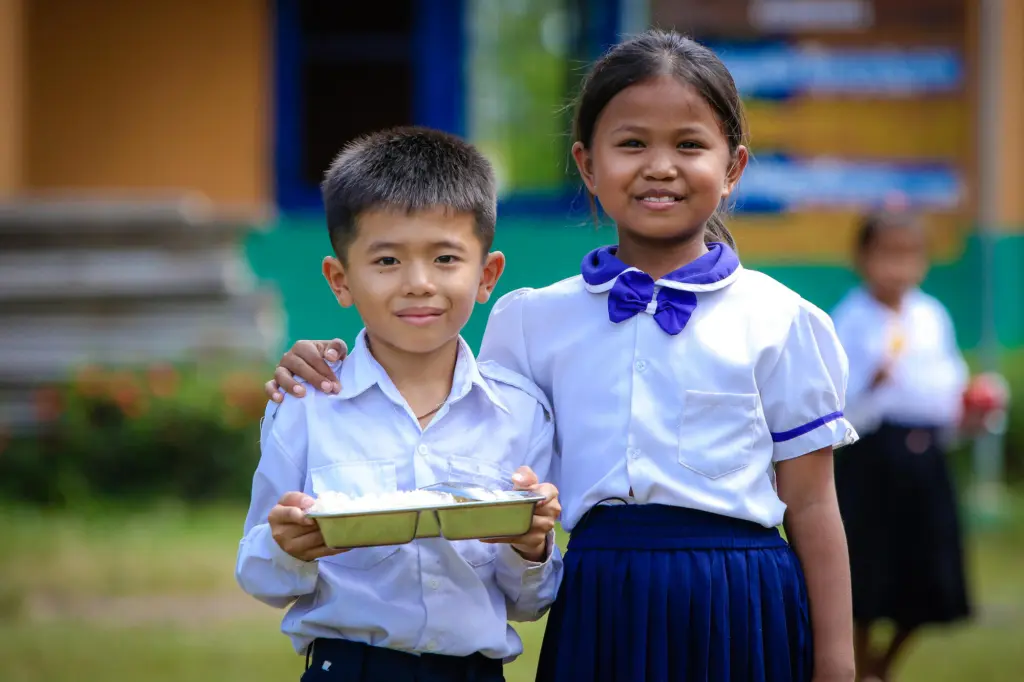
There is no “one size fits all” blueprint to building sustainable school meals programs. National leadership + local flexibility = sustainability. Infrastructure, policy environments, economic conditions, institutional capacity, climate, and cultural norms vary widely by geography — not only between countries, but within them as well. Strong national policy is a start, but even national policy should allow for decentralization as a means for sub-national adaptation and flexibility. School meals should be culturally appropriate, offering foods that are acceptable to the local population and sourcing ingredients from local farmers as much as possible. This approach supports a national policy that provides a set of core nutritious base foods with the local flexibility to adapt the menu to specific tastes and availability of complementary ingredients. Localizing school meals encourages community buy-in and ownership.
No person or nation is an island unto themselves. Even in the most remote places we are connected by global supply chains, information systems, financial systems, geopolitics, culture, and community. As such, strong partnerships are needed to build sustainable school meals programs.
Tapping into our global food system is critical to sourcing affordable school meal ingredients and creating a safety net when a shock disrupts local production. Efforts like the McGovern-Dole International Food for Education and Child Nutrition Program of the U.S. Department of Agriculture (USDA) have long supported the establishment and scaling of such supply chains that are essential to sustainable national systems. Sustainable supply chains need private sector partners who understand the value of school meals programs working at local, regional, and global levels to ensure affordable, cultural, nutritious, and resilient school meals programs.
Beyond supply chains, diverse and committed partners are needed to take a nascent school meals program to one that is playing a critical role in building a country’s prosperity. Between governments, international organizations, foundations, etc., none is more important than local communities. Yes, funding and technical capacity are key components often supplied by external donors, but local communities, including community organizations, are the ones who make these programs successful.
A USDA-commissioned report on the McGovern-Dole School Meals Program in Africa from 2022 identified private sector actors and local civil society as key partners for sustainability in resource-constrained countries.3 If the community doesn’t see the value in education or supporting school meals for all members of their society, then nothing changes. Sustainable school meals programs must not only rely on PTA members but put real effort into building the capacity of civil society and conducting community outreach to support school meals programs. National programs, especially early on, will be under-resourced to cover the great need. Community involvement (people, businesses, religious institutions, local NGOs, farmers) is an underutilized resource for creating the conditions needed for a sustainable school meals program. When communities participate in school meals programs, it can be the determining factor in long-term sustainability.

World Vision has supported school meals programs around the world for more than 30 years through programs such as the McGovern-Dole International Food for Education and Child Nutrition Program of the U.S. Department of Agriculture (USDA) and in partnership with the World Food Programme — currently working in more than 20 countries and supporting nearly 1 million children.4
World Vision brings strong commodity management systems, tools, and capacity via specialized staff and our proprietary Last Mile Mobile Solutions technology that provides end-to-end tracking and fraud preventions solutions. World Vision complements this with evidence-based models like Unlock Literacy, Citizen Voice and Action, and Inclusive Market Systems Development to strengthen systems for lasting impact. School meals programs are vital to a nation’s long-term investment in human capital and national prosperity, and World Vision is committed to supporting these programs in partnership with donors, national governments, private sector actors, and communities around the world.
Sources
1 Hunter, R. (1904). Poverty. The Macmillan Company.
2 World Health Organization & UNICEF. (2025). Global nutrition targets 2030: stunting brief. Geneva: World Health Organization and the United Nations Children’s Fund (UNICEF). https://doi.org/10.2471/B09383
3 United States Department of Agriculture Foreign Agricultural Service. (2022). Research and Learning of the McGovern-Dole School Meals Program in Africa: Extended Summary. July 2022. https://www.fas.usda.gov/sites/default/files/2022-07/MGD_Analysis_Extended%20Summary.pdf
4 World Vision International. (n.d.). School Meals as a lifeline: Enhancing child wellbeing in humanitarian emergencies. Retrieved February 21, 2026, from https://www.wvi.org/disaster-management/school-meals
