
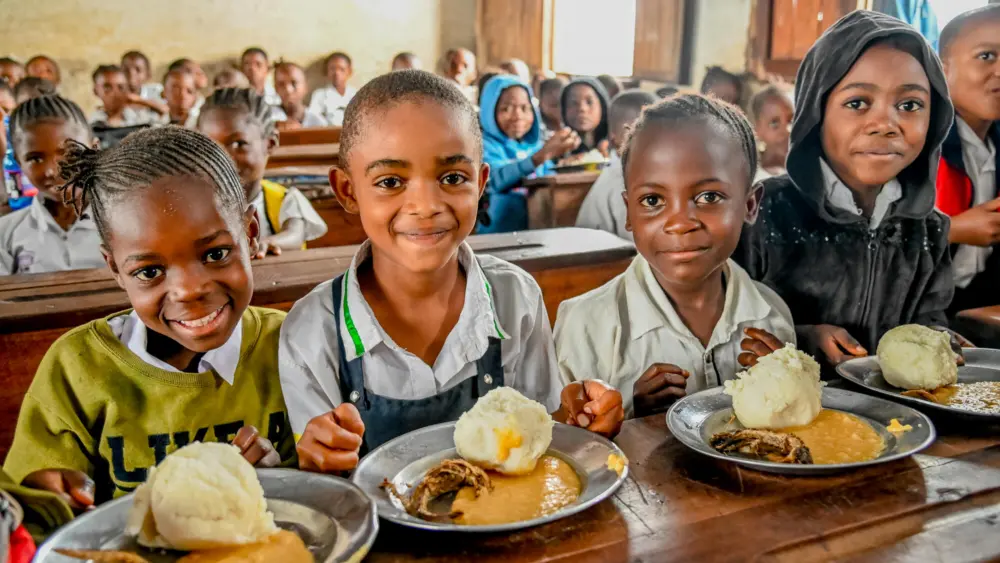
As the second blog in our School Meals Day series, this piece builds on the nutritional foundation of school meals to examine how they accelerate learning and improve education outcomes.
By Sheena Jones, Senior Business Development Manager, Food Security & Livelihoods, and Alisa Phillips, Senior Technical Advisor, Education, World Vision
When hunger is removed from the classroom, learning can begin. Across low‑ and middle‑income countries, school meals are consistently linked to improvements in enrollment, attendance, concentration, and learning outcomes, making them one of the most cost-effective investments available to education systems.
When a child sits down to a guaranteed meal at school, they receive the nutrition needed to fuel their brain, sharpen their focus, and unlock learning gains that no textbook alone can provide. School meals are a low-cost, evidence-based, strategic investment that strengthens education, supports local economies, and contributes to sustainable development. In low- and middle-income countries, a meal costing as little as U.S.$0.36 can increase school enrollment, improve attendance, and enhance learning outcomes. By helping ensure children are well nourished and in school, these programs lay the foundation for stronger, more resilient communities.
In many places around the world, families must frequently choose between sending their children to school or having them contribute to household income. In this context, many children often only receive one reliable meal per day, making school feeding programs critical for both nutrition and education.
Research demonstrates the measurable impact of school meals. A recent Cochrane systematic review found that school feeding programs in low- and middle-income countries increase school enrollment, strengthen learning outcomes, and support children’s healthy growth. Nutritional school meals are also associated with higher test scores and improved classroom behavior. A 2025 scoping review in BMJ Open by Amy Locke and colleagues found that students who received free, nutritious school lunches throughout primary school earned roughly 3% more as adults, with the largest gains observed among children from low-income families.
In more than 30 years of delivering school meals worldwide, World Vision has witnessed countless examples of gains in enrollment, attendance, and learning stemming from school feeding, especially for girls. In Rwanda, Zambia, Cambodia, Peru, and Malawi, 70-95% of children reported that meals improved their ability to concentrate in class. In the Democratic Republic of the Congo, attendance in 104 primary schools rose from 70 to 90% after school meals were introduced. And in Warrup State, South Sudan, World Vision’s World Food Programme-funded program saw school enrollment jump by 35% in 2023, from 31,000 to 42,000 students, after school meals were introduced.

World Vision’s school feeding programs reach one million children across 20 countries, with 70% of these programs operating in humanitarian or crisis settings. This global reach, combined with experience in fragile contexts, enables World Vision to implement programs that are tailored to local needs and operational realities.
Our deep community presence, expertise, and experience, robust school — community education collaboration, and long-standing partnerships with local governments and the World Food Programme allow us to design programs that are both technically sound and contextually relevant. We also work with ministries of education and national programs to strengthen program design, targeting, and systems for sustainable, government-led meals. Funding and technical partnerships with McGovern-Dole International Food for Education and Child Nutrition Program of the U.S. Department of Agriculture (USDA), World Food Programme, Education Cannot Wait, the European Union, UNICEF, and private donors have shaped this robust approach, which improves enrollment, stabilizes attendance, reduces afternoon absenteeism, and supports better learning outcomes and household food security.
World Vision champions home-grown and environmentally sustainable school meals, linking schools to local farmers, kitchen gardens, and resilient food systems. By integrating school meals within broader education efforts, including World Vision’s ENOUGH Campaign and global coalitions for universal school meals access by 2030, programs strengthen local markets, promote nutrition, and build long-term community capacity.
School meals represent a low-cost, evidence-based investment that generates measurable returns for children, communities, and broader economic stability. For only a few cents per meal, these programs improve school attendance, boost concentration, and enhance learning outcomes, translating into long-term gains in human capital. By supporting consistent participation in school, school meals contribute to more resilient communities and sustained development.
Programs funded through McGovern-Dole International Food for Education and Child Nutrition Program of the U.S. Department of Agriculture (USDA) advance its mandate to use U.S. provided commodities and financial assistance to reduce hunger and improve literacy and primary education, especially for girls, demonstrating how targeted, strategic investments can achieve both immediate and enduring impact.

School meals transform hunger into opportunity. Children like Isabel (pictured above), a participant in World Vision’s USDA-funded ANGEL program in Angola, gain the nourishment needed to attend school consistently, engage in learning, and pursue their aspirations. Isabel shared, “Before, I missed school often because I had nothing to eat. Now, with the school meals, I feel stronger and excited to learn every day. I want to become a doctor and help my community.”
These programs demonstrate how targeted, evidence-based interventions — combined with strong local partnerships — support not only individual children but also the broader communities in which they live.
Next up: we’ll zoom out from the classroom to show how school meals become a platform for communities like Isabel’s, powered by parents, farmers, cooks, and local leaders working together to strengthen education, nutrition, and resilience.
