Research
This publication proposes an expanded framework for health systems strengthening that fully integrates community health as a core component. While existing mod…
Health
World Vision helps strengthen health systems through training, enhancing diagnostics, and improving water and sanitation. Partnering with communities and governments, we help ensure quality, accessible care for the most vulnerable.
In many of the places where we work, health systems lack the funding, workforce, infrastructure, and policies needed to deliver even the most basic services. World Vision’s health system strengthening (HSS) efforts support a wide range of national health outcomes, including maternal, newborn, and child health. Through our Global Fund programs, we build local capacity — training staff in data collection and improving community-level diagnostics and treatment for malaria. Using private funding, we also responded to WHO and UNICEF’s call to improve clean water access, hand hygiene, and sanitation in healthcare facilities. World Vision committed to reach 800 rural healthcare facilities between 2019 and 2021 — more than any other NGO — and exceeded that goal. We surpassed this commitment. Our current target is to reach 3,000 healthcare facilities by 2030.
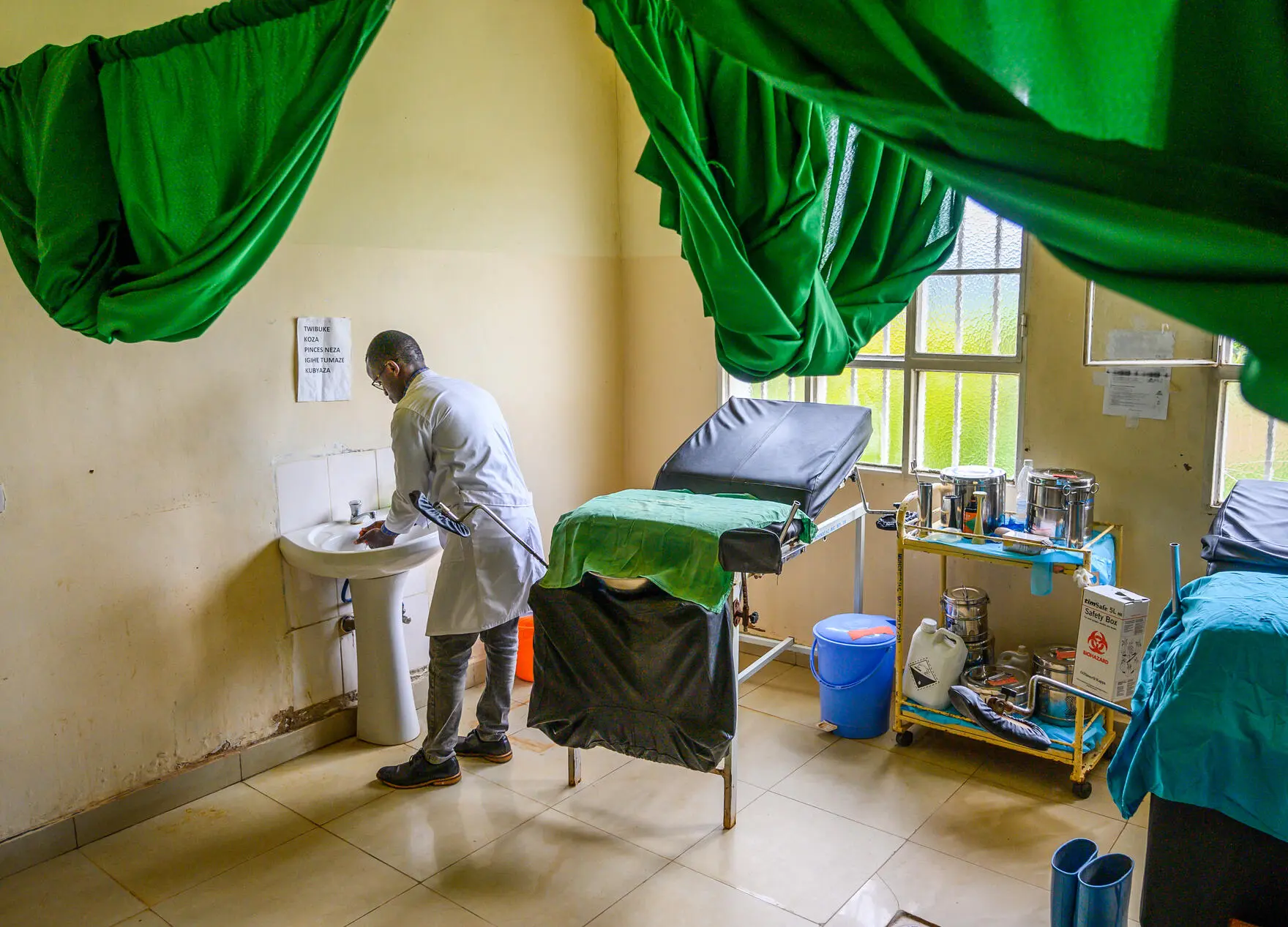
Our principle of working in close partnership with communities and national governments shapes our approach to health systems strengthening (HSS). We prioritize capacity building, collaboration, learning, and adaptation to support strategic, scalable solutions. Our work intentionally integrates crosscutting priorities, including gender equality and social inclusion, into every step of the process.
World Vision’s HSS strategy emphasizes district- and community-level approaches and focuses on:
Our HSS projects aim to build service capacity across all levels of the health system — national and subnational — to ensure communities have access to quality health services. We align our efforts with local Ministries of Health and their National Health Sector Strategic Plans, contributing to all six pillars of a functional health system:
We train healthcare providers in standard health services, supply/inventory management, correct use of medicines and medical equipment, on-the-job mentoring of trained healthcare providers, and development of quality healthcare through supportive supervision, as part of district health management teams’ strategies. Our approach aims to improve the quality and accessibility of services, focusing on priority interventions to reduce mortality and morbidity. World Vision’s interventions and technical assistance engage communities to advocate for and contribute to the development and implementation of an essential health package centered around community‐based approaches and integrating essential services to reach all members of the community, especially women and other marginalized populations.
World Vision uses proven methodologies for engaging communities to give feedback and improve quality and accessibility of services. These include:
Through our Global Fund grants, World Vision implements a wide range of health systems strengthening and resilient and sustainable systems for health interventions. In addition to addressing the three diseases targeted by the Global Fund — HIV, tuberculosis, and malaria — our efforts focus on building sustainable systems. We do this by enhancing community health service delivery, strengthening health information systems, and ensuring efficient supply chain and product management. These interventions promote equity and access and contribute to the broader goal of achieving universal health coverage.
Health management information systems and monitoring & evaluation (M&E)
World Vision has supported the development and enhancement of health information systems in Papua New Guinea (PNG), the Central African Republic (CAR), Haiti, Nicaragua, and Somalia. This includes establishing robust M&E frameworks and digital tools that enable timely and accurate data collection, analysis, and reporting across all levels of the health system.
In Somalia, we supported the revision of community data collection tools used by female health workers (FHWs), improving reporting on community-based activities. We also supported the rollout of DHIS2 and the shift from paper-based to digital reporting. To ensure sustainability, we trained health workers and administrators in the use of health information systems and M&E tools—promoting a culture of data-driven decision-making.
Health product management systems
World Vision supports efficient health supply chains by building capacity and partnering to help ensure timely and efficient distribution In PNG and CAR, we helped implement inventory management systems and supported warehousing and distribution efforts of health products. These efforts help track usage, reduce stockouts, and ensure that essential supplies are available when and where they’re needed.
Integrated service delivery and human resources for health
To support integrated service delivery, World Vision strengthens care delivery mechanisms across clinics and networks of care. In Somalia, we scaled up 59 tuberculosis basic management units to provide a broader range of primary health-care services. We also invest in the health workforce. This includes training health workers, particularly community health workers, to strengthen their technical capacity, improve quality of care, and ensure continuity of services at the community level.
This publication proposes an expanded framework for health systems strengthening that fully integrates community health as a core component. While existing mod…
In Uttar Pradesh (UP), India, a region facing high maternal and infant mortality rates and limited access to healthcare, World Vision implemented a three-and-a…
This case study, produced by the Berkley Center and the World Faiths Development Dialogue, explores the significant contributions and complex roles of faith-in…
