Reports
Today more people are on the move than ever before – more than twice as many as 10 years ago – with nearly half of them…
Child Protection
Disaster

In 2024, World Vision reached over 19 million children and their families across 65 countries with life-saving humanitarian aid — the highest number in our history. Working alongside communities and partners, we protect children and strengthen family care systems in some of the world’s most fragile and crisis-affected contexts.
Conflict and crises, including extreme environmental changes, exacerbate child protection concerns while also creating new ones as children are disproportionately affected by displacement. The indirect impacts of humanitarian emergencies pose a clear and present danger to children, particularly the most vulnerable. Global research indicates significant spikes in cases of children experiencing physical, emotional, and sexual violence, as well as a prevalence of child labor, during humanitarian emergencies. Children separated from parental care due to crises are particularly vulnerable to violence and abuse.
At the onset of a conflict or crisis, World Vision first seeks to ensure children have basic needs met and that safe and protective spaces exist for children to learn, play, and receive psychosocial support to cope with uncertain situations. We aim to reunite children with their families or provide them with access to appropriate family-based care. As emergency situations stabilize, World Vision works to support and strengthen formal and informal child protection actors, including faith leaders, to identify and respond to child protection risks in their communities.
Conflict and crisis can have a dramatic impact on the emotional and mental well-being of children. Disruption to family, school, and community social structures can be considerably distressing to children. Around the world, World Vision has equipped first responders to help through psychological first aid — a model to identify and respond to potential emotional and psychological distress and to provide basic care and, when needed, referrals to specialized services. During the COVID-19 pandemic, World Vision trained faith leaders to apply this approach to better serve the needs of their faith communities.
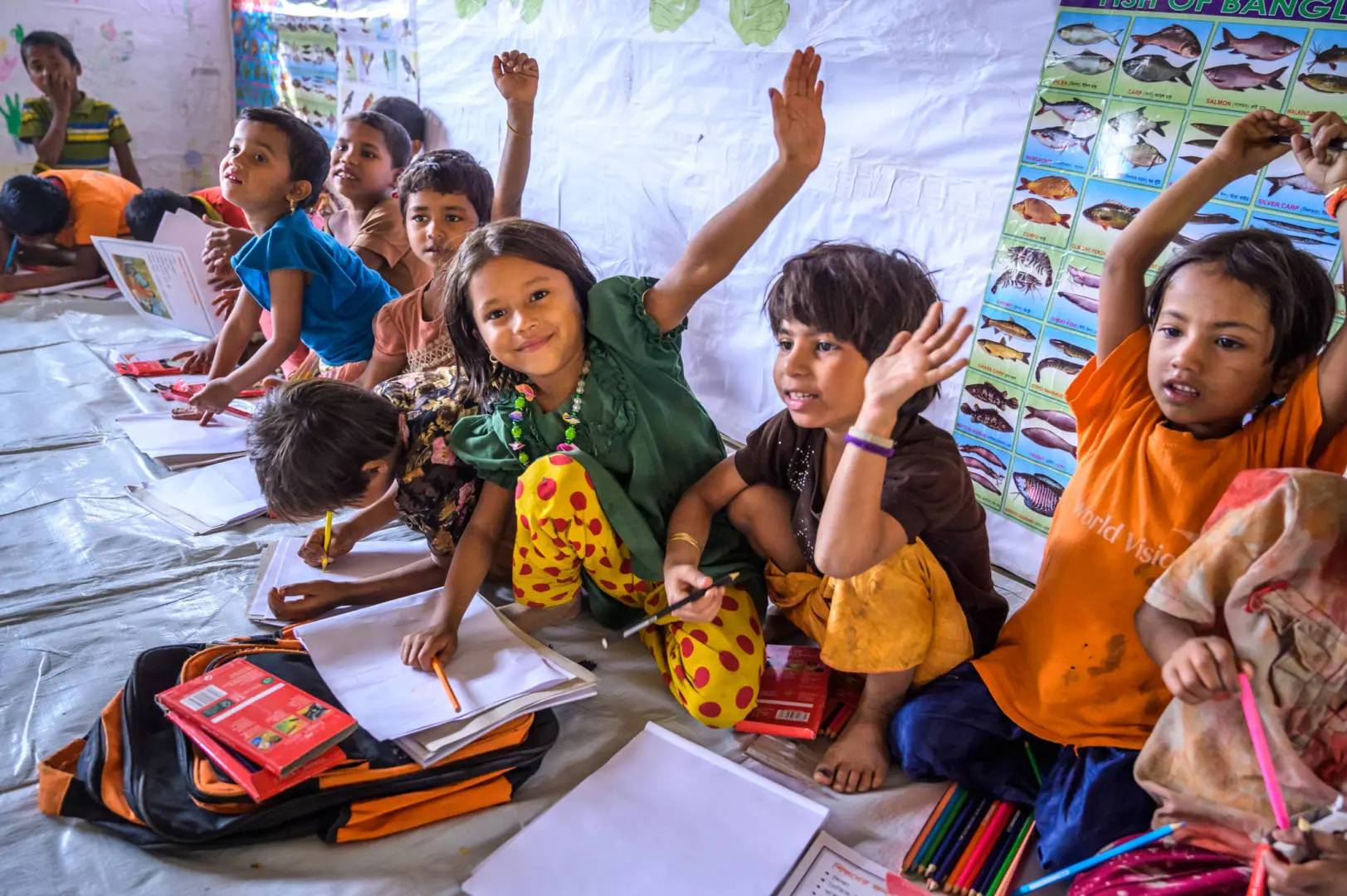
In emergency contexts, World Vision creates safe and protective physical spaces (Child Friendly Spaces) to support the resilience and well-being of children through community-organized, structured activities where children can gather to learn, play, and receive basic psychosocial support. These spaces can also serve as an entry point to assessing and serving broader family needs, including the provision of parental and caregiver support, within a community. For children especially affected by crisis — including armed conflict — World Vision works either directly or through qualified mental health and psychosocial support partners to provide access to tailored case management and referrals to professional clinical care when required.
World Vision prioritizes the well-being of the world’s most vulnerable children, including those outside of parental care who are susceptible to abuse, neglect, and exploitation. This is especially true of children separated from their parents due to crisis or conflict, those who have lost one or both parents to illness, and children in unaccompanied migration.
We value the family as the primary social unit and affirm its role as the main actor responsible for the care and protection of children. Children grow and thrive best in a family-based environment, not in institutional care — the detrimental impacts of which are now widely recognized.
For this reason, World Vision equips families to care for and protect children, reducing the risk of separation from their immediate and extended family. We also aim to strengthen systems that provide alternative community-based options to institutionalization, and we support residential institutions in transition and de-institutionalization processes. When a crisis or disaster separates children from their families, we work to locate and reunite family members as soon as possible, while ensuring children are cared for within family-based care whenever possible.
While our primary focus is to strengthen systems that allow the child to remain with family members, if remaining with the family is not in the best interest of the child, World Vision supports the family, community, and local authorities to find community-based solutions.
Colombia: Hope Without Borders
In Colombia, our Hope Without Borders project, funded by the Bureau of Population, Refugees, and Migration of the U. S. Department of State, is coordinating strategic interventions in protection, shelter and livelihoods for displaced Venezuelan populations and their socioeconomic integration and the prevention of migration through the Darian gap. Thus far, World Vision has enhanced the protection of 1,388 children and caregivers at risk, including unaccompanied and separated children arriving to Colombia.
Democratic Republic of the Congo: Emergency Response to Water, Sanitation, and Hygiene (WASH), Protection and Livelihood Needs project
In the Democratic Republic of the Congo, World Vision provides lifesaving support to internally displaced children and families in North Kivu. The U.S. government has provided critical funding to increase access to safe water and protection services which are essential for survival. WASH, Protection and Livelihoods activities are integrated to build the resilience of the most vulnerable individuals and families in the face of prolonged conflict and crisis.
South Sudan: Restoring Lives and Building Resilience (RESTORE)
In South Sudan, the RESORE project funded by U.S. government humanitarian assistance made notable advancements to building healthier communities for internally displaced people through integrated Agriculture, WASH, Protection and Health programming. Community level protection systems were significantly strengthened to prevent and respond to protection risks and cases of violence against women and children. There was a 57% increase in participants that knew how to respond to child protection incidents. Through safe spaces, women and girls received lifesaving services, psychosocial support and skills to generate income to meet basic needs of their family members. Women and girls were able to buy food and clothing for children and pay school fees.
Jordan and the Democratic Republic of the Congo: Systems Strengthening
World Vision has adapted our system strengthening approach for fragile contexts in Jordan and the Democratic Republic of the Congo. Working with staff and community partners and stakeholders, we mapped existing systems and structures with uncertainty in mind, leading participants through scenarios to anticipate future disruptions and their potential impacts on violence against children. Participants were supported in planning for how systems could be best positioned to respond to new and emerging changes.
Today more people are on the move than ever before – more than twice as many as 10 years ago – with nearly half of them…
Since February 2022, the war in Ukraine has displaced 7.5 million children, making it the largest human displacement crisis in the world today. Children have…
As Sudan faces a dire humanitarian crisis, largely unnoticed by the global community, the country grapples with unprecedented hunger levels driven by conflict,…
World Vision’s Child-Friendly Spaces offer safe, supportive environments where children can begin to heal and feel like kids again. Take a look at six places where these spaces, and the dedicated staff behind them, are making a difference.