
written by Matthew Stephens, Senior Technical Advisor for Child Protection, World Vision
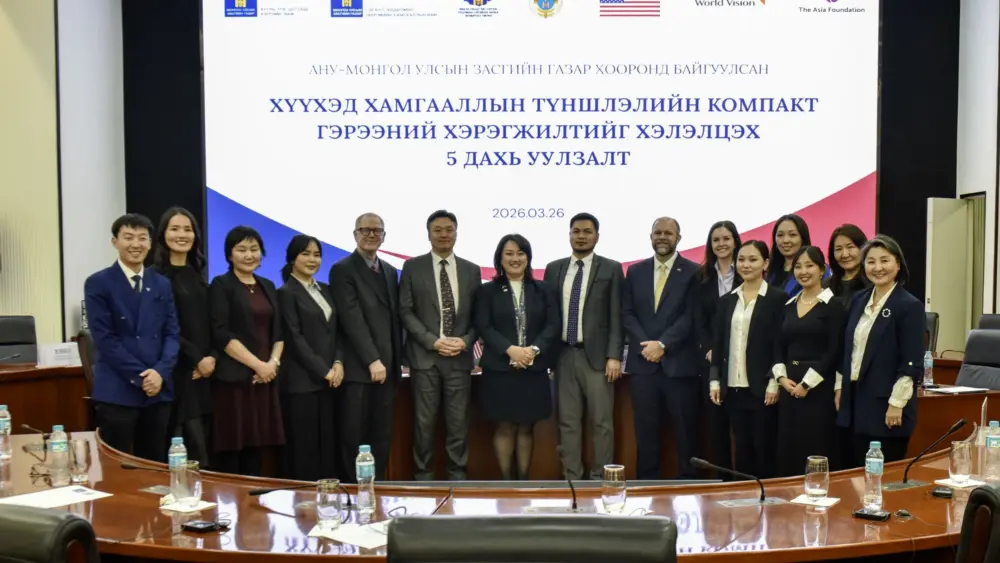
In a Ministry of Foreign Affairs conference room in Ulaanbaatar last March, government officials, civil society leaders, and implementing partners sat together to review six years of work to protect children from trafficking. What struck me most wasn’t the data or the numbers — it was the shared commitment in the room.
I had traveled to Mongolia to participate in the Child Protection Compact (CPC) bilateral dialogues between the U.S. Department of State, the Government of Mongolia, and implementing partners — World Vision and The Asia Foundation. The progress and achievements of this six-year partnership to sustainably strengthen national and local child protection systems — preventing and responding to child trafficking and exploitation — have been truly remarkable, and I’m proud of the work we’ve contributed to.
But coming out of that meeting, I found myself reflecting on a question I keep returning to: what makes systems change stick?
World Vision has been implementing a Child Protection Systems Strengthening approach in more than 60 countries since 2011 — over 15 years we’ve accrued some lessons on getting sustainability “right” (and sometimes wrong!). While none of the observations below are groundbreaking revelations, they reflect a practitioner’s perspective on elements worth keeping front of mind as we look to improve our practice and contribute to lasting systemic change for children.

Co-ownership and investment are critical
Any project — or organization — that sets out to influence systems change without the actual system owners and stakeholders as vested leaders and owners is bound to fail. This must go beyond “consultation.” Externally designed interventions that do not account for individual system and stakeholder dynamics, priorities, strengths, and assets cannot succeed. Plans must be co-designed and responsive to the needs of system actors, with priorities validated by both decision-makers and end-users, and a shared commitment to ownership of results and benchmarks for success.
One of the significant advantages of the U.S. Department of State’s Child Protection Compact structure is the agreement and commitment of both governments — prior to any U.S. public assistance commitment — to a shared set of priorities for strengthening the child protection system. Starting from a common understanding and vision for what change looks like, and who will own it, creates a solid foundation for the work to come.
Sustainability starts on day one
It should be obvious that “What does change look like?” must immediately be followed by “How will that change be sustained/maintained?”— but this step gets missed. It is never too early to begin transition and sustainability planning.
In recent years, World Vision has applied a sustainability framework (Rogers and Coates, 2005) assessing four key factors: motivation, capacity, resources, and linkages. Findings from multiple ex-post evaluations of our child protection programming (including in the Philippines and Mongolia) consistently point to the need to start planning early, with these factors front and center. Strategies should promote sustaining motivation (political and social will and momentum), capacity (institutionalized mechanisms for building and maintaining competencies and skills), resourcing (human and financial), and linkages (situating solutions logically within existing systems and structures). Nearly all of the observations that follow are directly tied to one or more of these factors.

Avoid duplicative or parallel systems
The focus must be on system strengthening, not system building — unless there is truly nothing to build upon, which is rarely the case. Taking time to assess and understand system assets, existing mechanisms, bottlenecks, gaps, and opportunities for improvement will ultimately save time, energy, and funding for both local and international partners. There is no one-size-fits-all solution for child protection system strengthening because every system is unique.
In Mongolia, we identified the absence of a dedicated trafficking in persons information management system (IMS) for identification, reporting, case management, coordination, and follow-up for trafficking cases. Working with government partners, we identified the opportunity to build on the architecture of the existing government domestic violence IMS — streamlining linkages between ministries and service providers and making use of existing referral pathways.
Ensure resourcing is part of the transition discussion
Perhaps the most important and possibly obvious point — but so often missed! A car doesn’t run without fuel, and a system doesn’t function without resourcing. No systems change can realistically take root without ensuring the financial resources to sustain it are available. This requires a commitment to analyzing and understanding existing investments and budget lines at the outset, accurately forecasting costs of scaling and maintenance, and advocating for resourcing for supervision, oversight, and administration.
Recent global analysis reinforces this challenge. The World Vision–supported Safeguarding Childhood global assessment on child protection financing found that, despite rising rates of child sexual abuse, most governments do not clearly identify or adequately fund related initiatives — particularly prevention — leaving critical gaps in child protection systems. It also underscores the importance of strengthening budget transparency, aligning financing with national policies, and ensuring accountability so that commitments translate into meaningful protection for children.
Targeted, evidence-informed budget advocacy — pursued as a joint effort between national civil society partners, survivors, and children themselves — can be quite effective in keeping national and sub-national budgets aligned with issues that matter most to children. World Vision is globally pivoting into efforts to shift the bottom line with government partners to ensure public financial resourcing aligns with the motivation and commitment to address issues affecting children — especially preventing abuse and exploitation.

Use data to drive decision-making
Making a case for increased investment requires evidence — and the efficient use of data to inform where investments are most needed and most likely to produce a social return on investment. Equipping governments with tools for regular, real-time reflection and resource allocation based on need is critical.
In Mongolia, the CPC project has worked with the government to produce annual data-driven reports to inform Ministry partners’ strategic planning, highlighting trends, gaps, and needs. In Romania, World Vision is working with partners eLiberare and Code for Romania to build a GIS mapping tool using existing government data to triangulate the prevalence of trafficking, vulnerability factors, and presence — or absence — of available protection services at the county-level. Where government resources are limited, using data to inform financial decision-making is a critical component of long-term sustainability.
Institutionalize outputs toward sustainable outcomes
For decades, implementers have thrived on output-oriented achievements — training stakeholders, conducting awareness campaigns, and producing reports. While easy to measure and report against, these outputs are much more difficult to sustain. Shifting the conversation toward sustainable outcomes is not new, but it requires intentional thinking across every project deliverable — critically asking how each deliverable will outlive the project.
The difference in thinking looks like this: not “training judges and law enforcement,” but co-developing curricula to be integrated into the national judicial and police academy coursework. Not “establishing youth clubs,” but developing a national, government-endorsed extracurricular program for children and youth.
Asking where each project deliverable should be situated within the existing system and what value it adds to the entity in which it resides can make the difference between admirable outputs and sustainable outcomes.
Learn more about World Vision’s work to combat trafficking in persons.
