
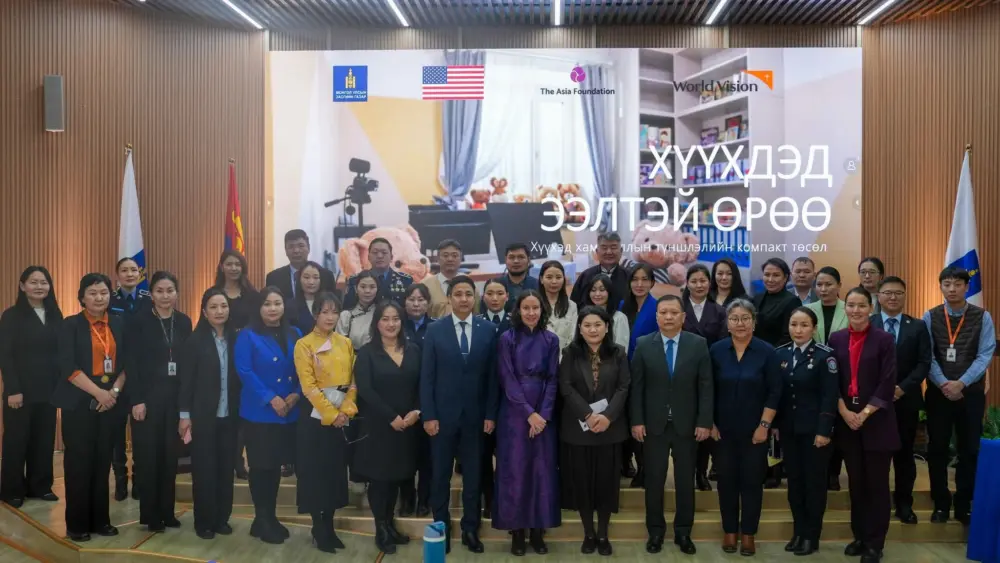
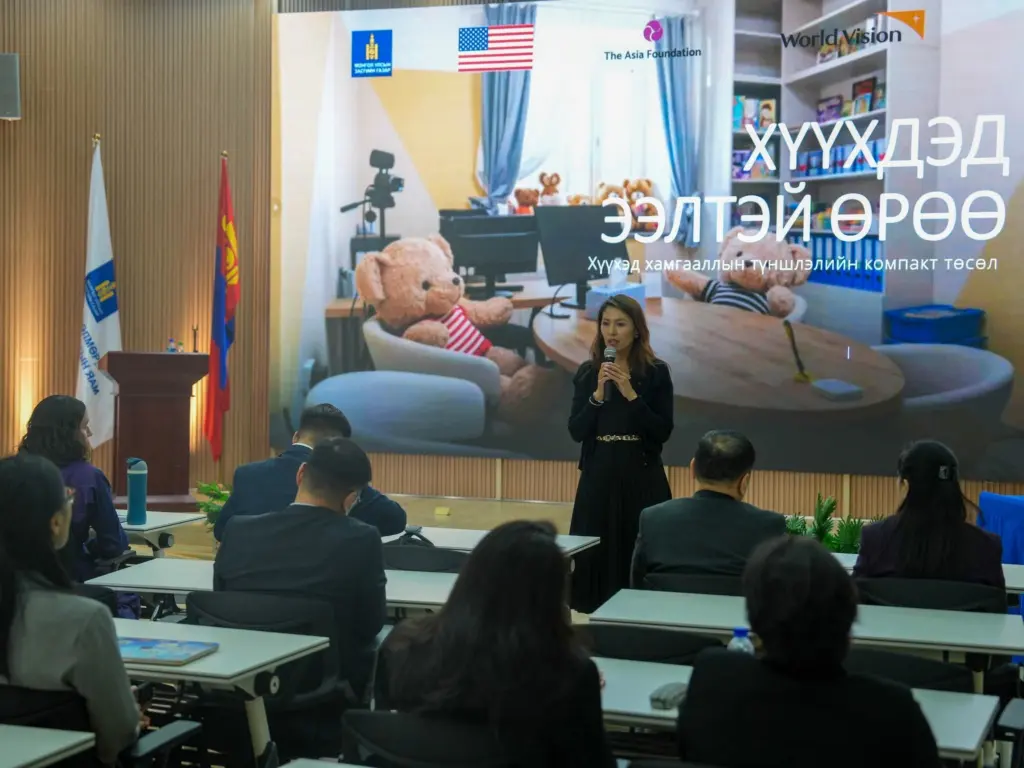
The U.S.–Mongolia Child Protection Compact (CPC) Annual Dialogue brings together government leaders, technical experts, and civil society partners to reflect on progress made to strengthen Mongolia’s child protection system and to reaffirm a shared commitment to sustainable, government‑led reform.
The U.S.–Mongolia CPC is a multi-year partnership agreement between the U.S. Department of State and the government of Mongolia to strengthen national child protection systems to prevent and respond to child trafficking. Funded by the State Department Office to Monitor and Combat Trafficking in Persons, World Vision is proud to lead implementation of the CPC project in collaboration with The Asia Foundation — working alongside government and civil society partners to advance sustainable systemic change to prevent child trafficking, protect and support child survivors, and to improve victim-centered and trauma-informed investigation and prosecution of traffickers.
Purpose of the dialogue
The Dialogue serves as both a key milestone and a moment of reflection — recognizing what has been achieved through shared investment and partnership, and reinforcing a collective commitment to sustain and build upon these reforms.
Discussions focus on:
- How government efforts and systems have been strengthened to prevent and respond to child trafficking
- What it takes to further institutionalize training, coordination, and accountability across sectors
- Priorities and next steps to sustain and advance Mongolia’s child protection reforms

Key accomplishments
Over the past five years, the CPC partnership has delivered tangible, system-level results now embedded within Mongolia’s national child protection framework:
- Policy and legal reform: Contributed to revisions of Mongolia’s Child Protection and Combatting Trafficking in Persons Laws and the development/strengthening of 14 national Standard Operating Procedures guiding identification, referral, investigation, and care for trafficking survivors and child victims of violence and exploitation. These reforms clarify roles across law enforcement, social services, and justice actors — from identifying cases to prosecuting traffickers and ensuring survivors receive care — strengthening coordination and accountability, and contributing to the creation of around 800 new social worker positions nationwide.
- Institutionalized training systems: Established institutional training models and national curricula co-developed with government ministries, enabling Mongolian institutions to lead and scale capacity-building efforts independently. More than 2,600 professionals across critical sectors have been trained.
- Multi-Disciplinary Task Force (MDTF): Established the MDTF to coordinate justice responses and service provision for child trafficking survivors, embedding coordination mechanisms within government systems to ensure reforms are owned, implemented, and sustained nationally.
- Trauma-informed justice and services: Eight child-friendly interview spaces established in police stations and government facilities, creating safer environments for children to share their experiences. More than 125 police officers trained to apply child-sensitive approaches, supported by national guidelines and practical tools that promote survivor-centered, trauma-informed responses.
- Prevention and youth engagement: Educators, youth leaders, and Child and Youth clubs equipped with toolkits on trafficking prevention, online safety, and life skills. Young people have led 30 local awareness campaigns, and child and youth online safety curricula are now endorsed and promoted nationally through government-supported platforms.
- Strengthened protection services: Four shelters supporting child survivors of trafficking were strengthened, and Mongolia’s first government-led national rehabilitation center for children affected by sexual abuse and exploitation was established. More than 200 government and NGO protection service providers were trained to provide care for child trafficking survivors.
- Early identification and prevention: Training and tools strengthened the ability of inspectors, service providers, and border officials to identify and respond to risks quickly, contributing to safer outcomes for vulnerable children including 116 at-risk individuals who chose to interrupt their travel (more than 80 of them children).
Partners and conveners
The CPC Dialogue reflects close collaboration among national and international partners, including:
- Government of Mongolia: Ministry of Justice and Home Affairs, Ministry of Labor and Social Protection, Prosecutor General’s Office
- Government of the United States: U.S. Department of State, Office to Monitor and Combat Trafficking in Persons (J/TIP)
- Implementing and technical partners: World Vision (lead implementer), The Asia Foundation
- Civil society and service partners: Mongolian Gender Equality Center, Talita Asia, Unbound Mongolia, Beautiful Hearts, Scout Association of Mongolia, Lantuun Dohio, Volunteer Center Mongolia, Adolescent Development Center, Education-Gateway to Future Development, and other national stakeholders
Why this matters
The Mongolia CPC demonstrates what sustainable child protection reform looks like in practice: government‑led systems, reinforced by trusted partners, with capacity built in from the start. As the Dialogue convenes this week, it highlights the return on U.S. government investment and offers a replicable model for future anti‑trafficking and child protection efforts worldwide.
