
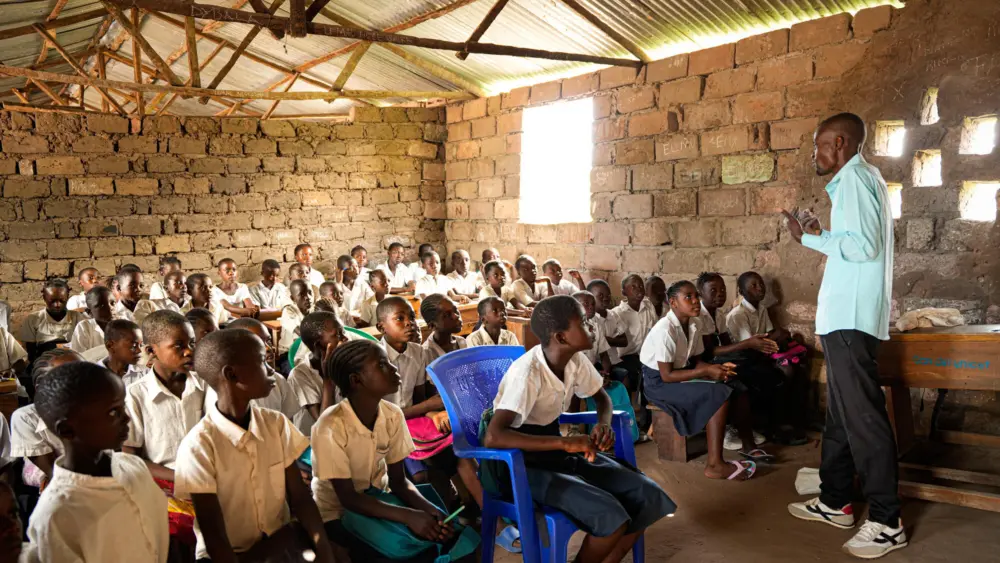
Teachers in crisis settings are remarkably resilient. That is true, and it is also the problem — resilience has become something we expect from teachers instead of something we build the conditions for. Celebrating their strength, their care for children, and their creativity costs us nothing. Building a system that helps them teach well and looks after their well-being costs something, and it is what actually changes what happens in a classroom.
Consider what a teacher in eastern DRC walks into. The room is overcrowded. The children in front of them are different ages and at very different levels; some have missed years of school, some have been displaced more than once, and many are carrying psychosocial distress into the classroom with them. And these children are also part of the 97% in the Democratic Republic of Congo (DRC) experiencing learning poverty — the inability to read and understand a simple story by age 10.¹
For these children, learning rarely happens in a stable classroom. It happens in rooms shaped by conflict, displacement, overcrowding, and uncertainty. In eastern DRC, these pressures are especially acute: schools continue to operate through ongoing insecurity, repeated displacement, and successive shocks.
And teachers keep showing up.
On World Teachers Day, we recognize the role they play in keeping learning going under conditions most of us will never face. We ask them to teach children to read, write, and build other foundational skills, and at the same time to make classrooms where children feel safe enough to learn at all. That expectation carries an obligation with it: teachers cannot create supportive learning environments unless they are supported themselves.
Research on teacher well-being in crisis and conflict-affected settings confirms how closely teachers’ own social and emotional well-being is tied to their ability to support learners.² For programs working in fragile contexts, that means improving foundational learning cannot stop at reaching more children or providing better materials. It has to include equipping teachers to teach — and to thrive — under extraordinarily difficult conditions.
Adapting Unlock Literacy to the reality of teaching during crises
World Vision’s experience in the DRC adapting Unlock Literacy, World Vision’s foundational literacy approach, shows what that looks like in practice.
The starting point was not to throw out the existing model. The core of Unlock Literacy — its focus on five foundational reading skills and on teacher professional development — held up. What had changed was the context, and with it what teachers needed.
Standard professional development content did not go far enough on the realities teachers were meeting every day: trauma and distress among learners, classrooms far past capacity, few teaching resources, and their own stress. So instead of asking teachers to adapt to a standardized model, World Vision adapted the model to teachers’ realities in the DRC.
Teacher professional development was expanded to include:
- Psychosocial support and trauma-sensitive pedagogy
- Teacher well-being and stress management
- Classroom management in overcrowded and resource-constrained environments
Teams did not build this from scratch. They drew on existing resources from partner organizations and education consortia, contextualized approaches that were already proven, and folded them into the Unlock Literacy framework. That let the program move faster and build on what the sector already knew.
From literacy to foundational learning
The adaptation surfaced a bigger question: if children are struggling across foundational skills, why address literacy alone?
Learning gaps in crisis settings do not sort themselves neatly by subject. A child who has been displaced, or out of school for a year, or moving between schools, is usually behind in more than one place at once.
Recognizing this, World Vision expanded the approach in the DRC to include numeracy alongside literacy. This represented a shift toward thinking about foundational learning more holistically — recognizing that children affected by crisis need opportunities to rebuild the range of foundational skills necessary to continue learning.
Building ongoing support, not one-off training
Changing the training content was not enough on its own.
Teachers need room to try strategies, compare what works, learn from each other, and get support as conditions in their classrooms shift. So the adapted approach put professional development inside ongoing teacher support rather than relying on standalone training sessions.
Peer learning circles gave teachers a place to share what they were seeing, work through problems together, and take new strategies straight back into their classrooms. What happened in those classrooms then shaped the next round of learning. Professional development became a continuous process grounded in teachers’ daily work.
Reaching the children who need support most
The adaptation also sharpened attention to which children were actually benefiting from instruction.
In overcrowded classrooms with learners at widely different levels, generalized instruction can easily leave the children who have the greatest needs behind. Teachers began using the Unlock Literacy approach more deliberately to identify those children and give them additional support, which tightened the link between what a teacher does and what a particular child needs.
In crisis contexts, where every interruption to schooling widens existing gaps, that kind of deliberate targeting matters enormously. Keeping schools open is essential. It is not sufficient if the children who have fallen furthest behind stay invisible inside the classroom.
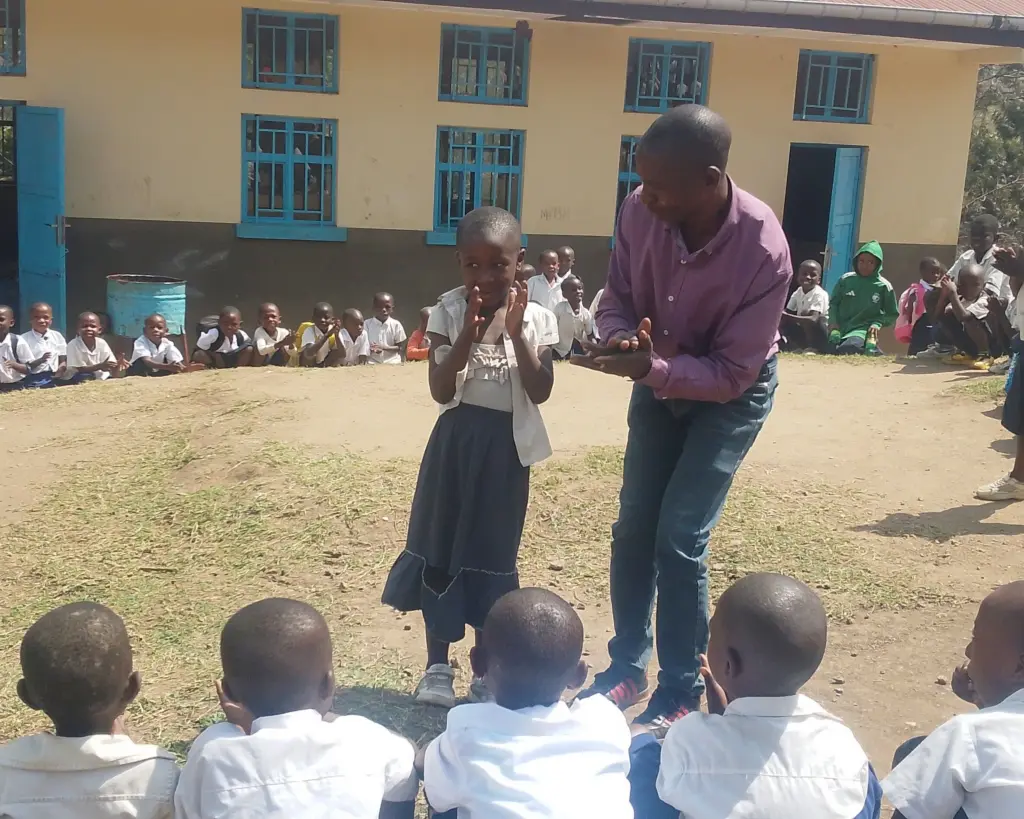
Through patience, encouragement, and trauma-sensitive teaching practices, teachers help students affected by conflict build confidence, develop positive relationships, and feel valued in the classroom.
Supporting teachers is a foundational learning strategy
The DRC experience points to a broader lesson for education programming in fragile and conflict-affected settings.
We usually frame foundational learning in terms of curriculum, instructional methods, assessment, materials, and time on task. Those all matter. But in crisis settings teacher well-being is high on the list too.
A teacher carrying significant stress, in a room full of children carrying their own, needs more than a new instructional technique. They need workable strategies for a complex classroom, colleagues to learn from, tools for responding to children’s psychosocial needs, and a system that notices how they are doing.
None of this means discarding proven education models every time a crisis hits. The DRC experience suggests something more practical: keep what works, and be willing to re-engineer how it is delivered when the context demands it.
Real constraints remain. Class sizes still stretch teachers past what any one person can manage. Adding content to professional development depends on motivated teachers and support structures that function. And without crisis-responsive teacher development frameworks at the system level, this kind of adaptation still rests largely on local initiative.
The direction, though, is clear. On World Teachers’ Day, celebrating teachers should mean more than praising their resilience or calling them superheroes. It should mean asking what systems, tools, and support they need, so that resilience is not simply something we expect of them and then move on. Strengthening foundational learning in a crisis environment takes changing how we support the people who make learning possible. When teacher development reflects what teaching during crisis really looks like, and when teachers’ well-being is treated as part of educational quality rather than a nice addition to it, teachers can keep teaching and children can keep learning.
Written by Charbel Chidiac, Senior Advisor, Education in Emergencies, and Alisa Phillips, Senior Technical Advisor, Education
References
¹ UNESCO. Democratic Republic of Congo: Education Country Brief. January 2024.
² Falk, D., Varni, E., Finder Johna, J., & Frisoli, P. Landscape Review: Teacher Well-being in Low Resource, Crisis, and Conflict-affected Settings. Teacher Social-Emotional Well-being Task Team, Education Equity Research Initiative, INEE, USAID/ECCN, Washington, DC, August 2019.
