

A new advocacy effort is bringing visibility, voice, and momentum to the fight against neglected tropical diseases in Mali.
In Bamako, Mali, a significant step forward has been taken in the fight against neglected tropical diseases (NTDs): the official installation of Mali’s NTD Ambassadors. Ambassadors Palmer Marshall and Binguini Bakhaga — a renowned Malian musical duo and married couple known as the “Couple Keïta” — have committed to advancing public health and will play a key role in increasing visibility and advocacy for NTD elimination in Mali. The duo, whose nickname “Keïta” is traditionally associated with leadership, royalty, and Mali’s imperial history, bring both cultural influence and national recognition to this effort.
This moment signals a renewed national commitment to amplify the voices of affected communities, strengthen partnerships, and accelerate progress toward eliminating diseases that continue to impact the most vulnerable. For World Vision, the Ambassadors highlight a broader vision for NTD elimination — one that places people, systems, and sustainability at the heart of programming.

During the celebration of World NTD Day, the artist couple Palmer & Binguini, represented by Palmer, were inducted as Goodwill Ambassadors for the fight against NTDs in Mali.
Advancing NTD elimination through partnership
The NTD Ambassadors initiative is rooted in strong collaboration with the Ministry of Health and Social Development and the National NTD Program. In Mali, World Vision partners closely with government institutions to help ensure that NTD interventions are country-led, aligned with national strategies, sustainable, and embedded within existing structures.
Through national coordination platforms and multisectoral committees, World Vision supports efforts to:
- Strengthen governance and accountability for NTD elimination
- Elevate NTDs on the national agenda through high-level advocacy
- Mobilize cross-sector partnerships, including private sector engagement
Working in close partnership with national and regional health authorities, these efforts are embedded within existing systems — helping ensure that NTD interventions are coordinated, scalable, and integrated into the broader health system.
The NTD Ambassadors reinforce this approach by serving as trusted public champions — amplifying national priorities, strengthening visibility, sustaining momentum for NTD elimination at all levels, and keeping attention focused on those most affected.
Together, these efforts strengthen national ownership of the NTD agenda and reinforce coordinated, system-wide approaches to elimination. By supporting coordination bodies and engaging leadership at all levels, World Vision helps ensure that NTD efforts are not isolated, but fully integrated into the broader health system.
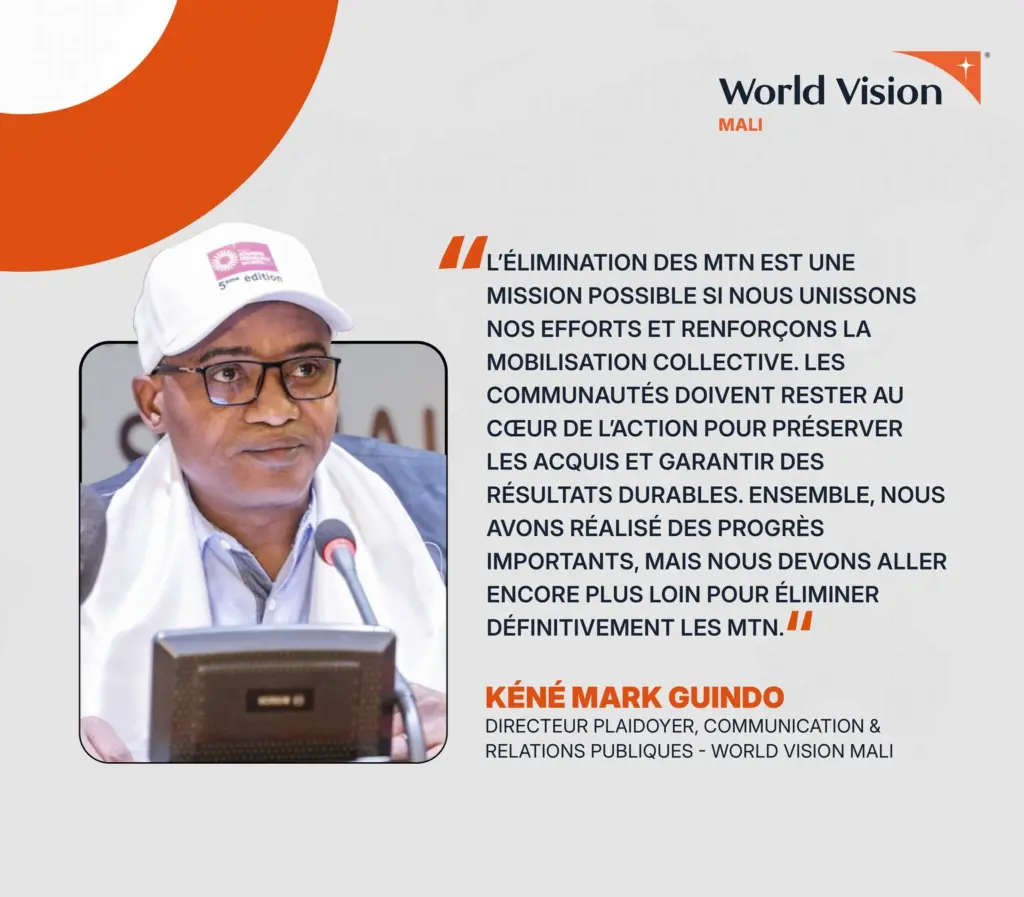
“Eliminating NTDs is a mission that can be achieved if we work together and strengthen collective mobilization. Communities must remain at the heart of the action to preserve the gains made and ensure sustainable results. Together, we have made significant progress, but we need to go even further to eliminate NTDs for good.” —Kéné Mark Guindo, Director of Advocacy, Communication & Public Relations – World Vision Mali
Integration: Reaching more people, more effectively
World Vision’s NTD approach is rooted in integration — linking prevention, treatment, and care across health services and community platforms. In practice, this includes:
- Combining health education, case identification, and referral systems through community health workers
- Integrating NTD activities into routine health services and outreach campaigns
- Strengthening morbidity management and disability prevention for those already affected
This integrated approach increases efficiency, reduces duplication, and ensures that individuals receive holistic, continuous care rather than fragmented services.

“Neglected tropical diseases continue to disproportionately affect the most vulnerable populations, often in silence. Eliminating them requires much more than medical interventions: it relies on strong community mobilization, ongoing awareness, and collective commitment at all levels.” —Jean Jacques Tougoue, Technical Director World Vision – Fight against NTDs
Shining a spotlight on the most vulnerable
At the heart of World Vision’s work is a clear priority: reaching the most vulnerable. NTDs disproportionately affect people in remote, underserved, and marginalized communities — those with the least access to care and low visibility in national discourse. This includes people living in rural areas with limited access to services, individuals with NTD-related disabilities, and women and children who face heightened barriers to health services.
The NTD Ambassadors play a critical role in changing this narrative. By engaging with media, participating in public events, and advocating at national and regional levels, they help to:
- Raise public awareness and understanding of NTDs
- Reduce stigma and discrimination associated with NTD-related disabilities
- Encourage early care-seeking and community participation
Through their work, the Ambassadors help ensure that the voices of the most vulnerable are amplified, fostering visibility, equity, and community engagement— essential for mobilizing resources and sustaining political commitment.

“Beyond our status as artists, we are deeply committed to human causes. Neglected tropical diseases make little noise, but they destroy lives. We have chosen to put our voice, our image and our influence at the service of their elimination. This role of ambassador will not be symbolic: it will be concrete, useful, and resolutely committed.” —Palmer & Binguini, Ambassadors for the fight against NTDs in Mali
A catalyst for sustained impact
The installation of Mali’s NTD Ambassadors signals a shift toward stronger national ownership, greater visibility, and sustained action. Working alongside government, communities, and partners like World Vision, the Ambassadors are driving momentum toward a future where NTDs are no longer a burden on the most vulnerable, communities are empowered and informed, and health systems are inclusive, integrated, and resilient.
