
For more than ten years, the All Children Reading Grand Challenge for Development, a partnership involving World Vision and the U.S. and Australian Governments, led efforts to advance educational technology (EdTech) innovation and research to enhance reading outcomes for marginalized children in low-resource contexts.
However, despite the flexibility of the Grand Challenges funding mechanisms, many barriers still prevented local organizations from accessing funding opportunities. These included language barriers, complex submission requirements, and limited understanding of U.S. government regulations, all of which deterred local innovators from competing in innovation-focused prize calls.
To address these challenges, All Children Reading’s Challenge Management Group at World Vision reflected on the U.S. government’s Localization Vision and Approach to identify opportunities to better engage local organizations of persons with disabilities, strengthen their capacity, and elevate their technical expertise to drive a wider perception shift around the role of local organizations as key partners.
Simplifying Proposal Requirements
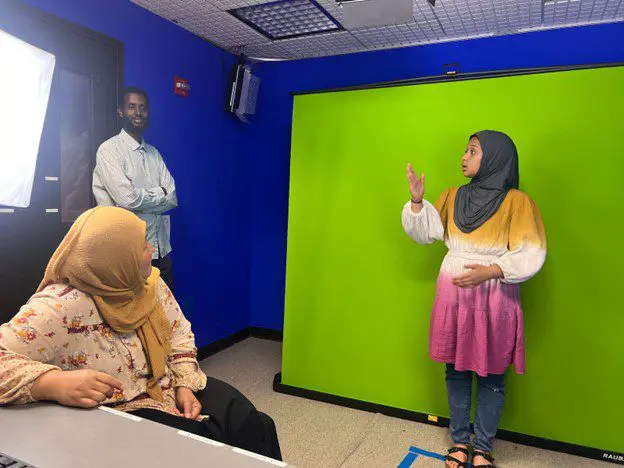
To improve access to and equity in prize competitions, All Children Reading modified their prize competition design. In September 2022, additional funding from one of the All Children Reading Founding Partners (World Vision) supported the Sign Language Books in Action competition, which focused on the distribution, promotion, and use of more than 1,300 accessible digital books. All Children Reading streamlined the competition requirements and allowed Deaf-led organizations, for whom English may be a third or fourth language, to submit video-recorded proposals in their respective local sign languages, accompanied by English captions. The innovative expansion of proposal submission requirements to include sign language reflected both the U.S. government’s Acquisition and Assistance Strategy, which emphasizes accessibility in the acquisition process, as well as an inclusive development approach.
Targeting Advertising via Local Social Media and Listservs
All Children Reading shifted its advertising focus to local social media and listservs, boosting applications from local organizations and effectively reaching its target audience. For example, initial advertising for the Begin with Books prize yielded 34 applications but only nine from target countries and none from local partners. In subsequent competitions, All Children Reading focused on Facebook as the center of communication around competitions and increased ad spend on the platform. All Children Reading also targeted local listservs and organizations working with children with disabilities, leading to 11 of 17 applications from local organizations for the Ready2Read competition and seven out of seven applications from local Deaf-led organizations for the Sign Language Books in Action competition.
Transitioning from Sub-Awardee to Prime Awardee
Under the Begin with Books prize, local organizations of persons with disabilities were essential sub-awardee partners. All Children Reading solicited feedback from the international prime awardees and also assessed the capacity growth of the local sub-awardees over the course of the initial two-year projects to support local scaling and usage efforts. Subsequent competitions aimed to scale the innovations developed in prior competitions, and they were targeted directly to local organizations. In one case, the local partner became the direct grantee and collaborated with the international partner as their sub-awardee.
Implementing Mentor-Driven Fund Management
During the award process, the team used milestone-based awards with local partners to reduce the compliance and reporting burden often associated with other funding mechanisms. The project manager worked closely to guide the local Deaf-led organizations through the milestone development process and modify scopes of work and timelines to support improved outcomes. All Children Reading also established guidance on how to best forecast and front-load milestones to avoid budget shortfalls and activity stoppage for local partners with limited reserves. This resulted in improved efficiency and avoided multiple contractual modifications or activity completion delays.
To drive agility and reduce the burden of email, the program manager initially instituted weekly virtual meetings with local partners and their sign language interpreters and used shared notes to establish open communication and to quickly react and adapt when needed. Using an “on-demand approach” that was responsive to local partners’ requests for support and availability, meetings shifted from weekly- to bimonthly- to monthly as the project progressed. The emphasis on mentoring, combined with a flexible approach, provided the necessary support to local partners and reduced compliance and reporting burdens.
Bringing a Localization Vision to Life
The U.S. government’s commitment to innovative and inclusive funding approaches, exemplified through initiatives like the Grand Challenges for Development, paves the way for meaningful collaboration and impactful projects. When All Children Reading first began, localization did not have the same focus in the development and humanitarian aid community as it does today. As the priority to strengthen and directly fund local partners grew, All Children Reading knew it could make a difference in this area. Donors and implementing partners must continue to actively break down barriers and engage with local organizations—especially those led by and serving marginalized populations—to ensure that the vision of inclusivity becomes a reality and marginalized communities are empowered to drive positive change within their own societies.
This article was originally published on a former U.S. government platform dedicated to development partnerships. The article was written by Lauren VanEnk, former Senior Technical Advisor for Locally Led Development at World Vision; and Thandeka Nkhonde, who served served as a Education Technical Program Manager with World Vision and held a role in higher education program management for the U.S. government in Malawi.
