
For millions of women and girls, the distance to the nearest water source shapes every part of life, from education and income to family relationships and personal dignity. When access to water improves, everything else changes with it.
World Vision’s Beyond Access program integrates water, sanitation, and hygiene (WASH) access with behavior change and women’s economic empowerment. Launched in four countries in 2022, the program places women and girls at the center of development. Phase 1 endline results show significant gains in women’s water access, savings, income, and decision-making power.
Based on these outcomes, the program is expanding. During Phase 2, Beyond Access aims to reach 360,000 people across 12 countries on three continents.
Recently, Kristie Urich, WASH technical director at World Vision U.S., spoke with two leaders implementing the program: Nobuhle Mlotshwa, Beyond Access coordinator with World Vision in Zimbabwe, and Neema Mwambo, Beyond Access project coordinator with World Vision in Tanzania. Zimbabwe was part of Phase 1 and continues into Phase 2, while Tanzania has recently begun implementation as part of the program’s Phase 2 expansion.
In this conversation, they share what life is like without reliable water, how communities change when water is closer to home, what it takes to build effective women’s empowerment programs, and their hopes for the future.
This interview has been edited for clarity and brevity.
Kristie: What is day-to-day life like for women, girls, and families in Tanzania when they don’t have access to water?
Neema: In many communities in Tanzania, girls and women are responsible for walking great distances to fetch water. Since women spend most of their time doing this, it limits their engagement in activities like income generation, family care, or participating in training opportunities.
For girls, this means their availability for schooling is limited. Their performance becomes poor, which can limit future job opportunities. This means society fails to utilize the potential of many women and girls.
Kristie: How have you seen this affect men?
Neema: Women do not have enough time to spend with their families, which can lead to conflict and separation. Although men are often the primary providers, they lack support from wives who could otherwise engage in income-generating activities. As a result, men must spend longer hours working to meet their families’ needs.
Kristie: When Beyond Access Phase 1 started in Zimbabwe in 2022, what were some of the biggest challenges communities, and particularly women, girls, and families faced — in areas like education, livelihood, and well-being?
Nobuhle: The absence of water has a significant effect on whether a woman or a girl can access opportunity, flourish, and reach their full potential. When you ask women of their vision and dreams to empower themselves, they say they cannot accomplish their dreams because of the time they take to fetch water. They are responsible for getting water before they do anything else. Even when there are opportunities for women to join economic empowerment opportunities, like savings groups or financial literacy, lack of access to water was a barrier to these programs’ success. When you offer training, women say they can’t come because they’re fetching water and when they return, they have to prepare food for their kids. Most livelihoods rely on water. Without water, women are also not able to embark on livelihoods that would enable them to contribute to household economic status.
Then there is an issue of dignity. You have dignity if you are clean, and water is essential for hygiene. The lack of water during menstruation also limits women’s participation in activities and girls’ attendance at school. In our culture, women are measured by how they perform household chores, yet most tasks — cleaning, bathing, washing, and cooking — require water. When women cannot accomplish them, it affects them mentally and leads to the perception that they do not contribute. Ultimately, lack of water undermines their confidence.

Kristie: What are some of the biggest changes you’ve seen in the lives of women, their families, their communities since Beyond Access started?
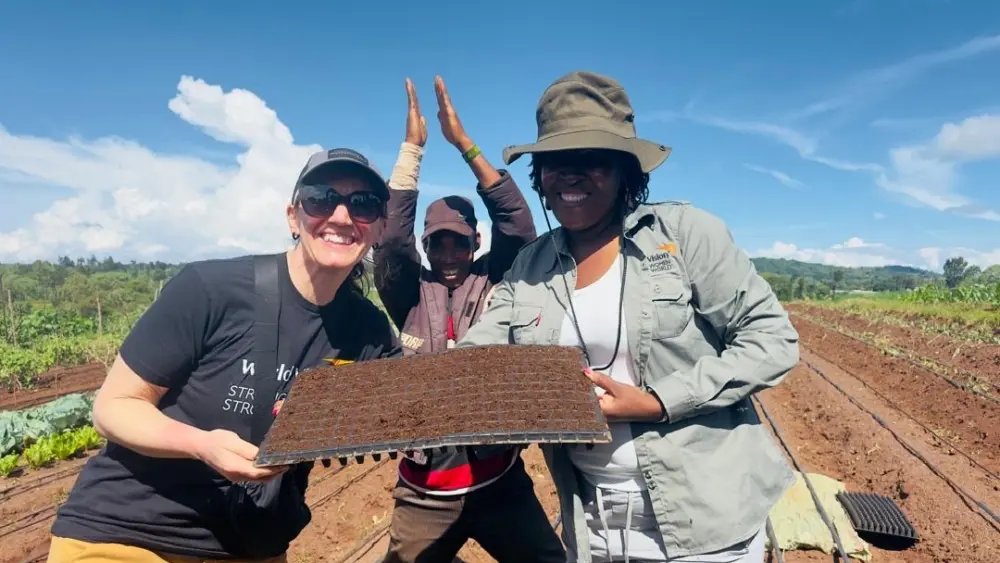
Nobuhle: One of the most significant changes I’ve seen in our project areas in Zimbabwe is women now have time to do other activities. For the first time, they have time to socialize. To sit down with friends and share stories and concerns. They now have time to participate in savings and livelihood projects. Because they have regained time and have access to water, they participate in community agriculture projects, selling produce to support their households and communities.
Kristie: When you talk about empowering women, sometimes men feel threatened. Can you share what you learned in Zimbabwe around engaging men?
Nobuhle: While our focus is to economically empower women, it is key to involve men as they act as a support system and can determine how far a woman can go in her empowerment. Water decisions are often made by men; but their consideration is not about the distance to water because they don’t walk it. Men raise issues like water troughs for livestock. So when we make decisions around water access, we need to include women and men. We must be clear that our programming is not to disempower men. We are not saying we want women to be above men. We want them to be equally empowered and for men to assist us in empowering women and for men to know that our programming does not just benefit women, but the whole family and community. We remind them, when women can assist in increasing household income, it benefits their children, the community, and society.
Kristie: What changes do you expect to see in the lives of women and families once water is closer to home and other activities have been implemented?
Neema: What I really want to see are happy families and children with hope for their future. I want to see communities become financially independent and resilient so they can face stress like drought. I also want to see women participating in decision-making roles. I want to see them have savings and access to financial services. I want to see all children going to school and dreaming bigger and believing they can achieve it. This is all possible without the stress of lack of water.
Nobuhle: Empowerment starts with an individual. The foundation is for our women and girls to say, “I can do it!” And for men and boys to say, “Women and girls can do this!” When we have confident and assertive women and girls anything layered on top of that will succeed. I want to see all generations flourishing and empowered, so couples and families are happy, confident, and supportive of each other. Women’s economic empowerment means women can thrive in whatever environment they are, because their potential is coming from within.
Kristie: You’re painting an incredibly beautiful picture of restored relationships — restored with yourself, restored with your partner, your family, and your community. How will you know that the program is successful and sustainable? What are we doing to ensure that the benefits we’re investing in will continue in the future?
Nobuhle: To help ensure the program is successful and sustainable, it’s important to integrate with other sectors. If we integrate with education, livelihoods, health and nutrition, sponsorship, and child protection, we enhance each other’s work. When we integrate with livelihoods and education, the sustainability of the WASH infrastructure we set up is guaranteed, because the community is utilizing the water to make an income, which they can now use to sustain, replace, and maintain the infrastructure. We must also work on mindset so a women can see the potential in herself. The mind drives everything. Work on the mind, then the rest will follow.
Neema: Building community ownership is key. When we bring water supply systems to the community, we must build the capacity of the community-based water supply organizations so they can maintain and expand the project so that when we come back many years later, you see a system still flourishing. For hygiene and sanitation, we want to establish WASH clubs in schools, so knowledge and tools cascade to the community when we’re no longer there. And finally, mindset change within the community.
Kristie: Is there anything you’d like to say to people who are supporting this work or that we’re inviting to help us expand the program?
Nobuhle: You are providing access to water, but you are also unlocking opportunities. For vulnerable communities, you are breaching the barriers women, girls, boys, and men face. Bringing water to our communities unites our families, reducing the gender-based violence which can emanate from lack of water and the time spent fetching it. It means parents can provide for their children. Children can go through their education and follow their dreams, so the world operates with people who have their visions fulfilled. Providing water fulfills someone’s vision, gives someone hope, and restores dignity. Thank you so much for your support and please continue supporting us. Together, we are reaching every heart with just a drop of water.
Neema: Your support is not just an investment in water, it is an investment in dignity, in opportunities for children in Tanzania, and the entire community. Investing in Beyond Access allows women to reclaim hours wasted in fetching water, and to invest those hours in economic activities. It allows children to go to school, offering them opportunities for growth and development. It offers families the opportunity to enjoy life in all its fullness, building peace and love within the family. You are investing in empowering our communities, to stand up for themselves and be able to say, “We can!” You are building the resilience of the community. You need to know that investing in water is not a charity. It’s justice, because you are giving life back to the people that you are investing in. It’s not only about bringing the water closer but bringing hope. Once you have water in communities, people start to dream big. Thank you so much for that.
Photos courtesy of Kristie Urich, WASH technical director at World Vision U.S.; Nobuhle Mlotshwa, Beyond Access coordinator with World Vision in Zimbabwe; and Neema Mwambo, Beyond Access project coordinator with World Vision in Tanzania
