
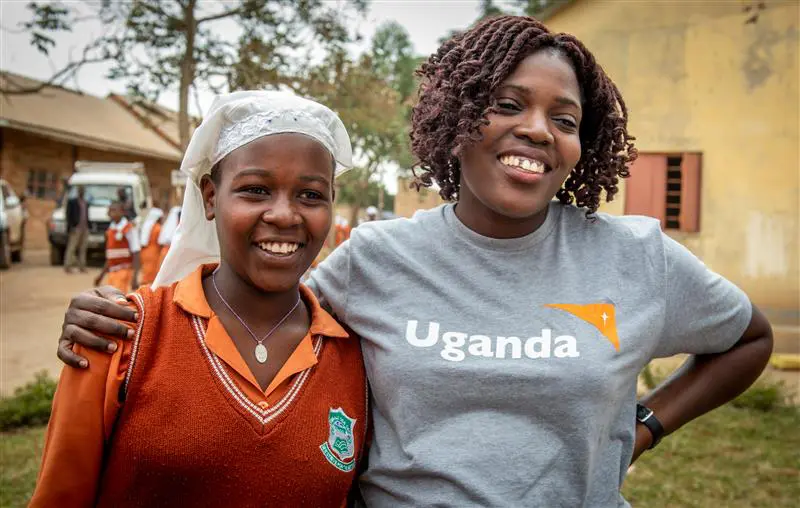
On World AIDS Day, the global community pauses to reflect, recommit, and reimagine the path to ending HIV/AIDS. For World Vision, this day serves not only as a commemoration but also as a call to action — a testament to the power of evidence-driven leadership, strategic partnership, and relentless innovation.
From Faith-Based Mobilization to Systems Transformation: Lessons from the Frontlines
The story of World Vision’s HIV/AIDS response is one of evolution and impact. In the early days of PEPFAR, World Vision recognized that stigma and silence were as formidable as the virus itself. World Vision was one of the first of many Christian organizations to support PEPFAR, not only to stop the deadly spread of HIV but also to care for children the epidemic left behind. By mobilizing faith networks and local leaders in high-burden countries like Kenya and Zambia, we pioneered approaches that reduced stigma, shifted social norms, and increased HIV testing and PMTCT (prevention of mother-ot-child transmission) uptake, laying the groundwork for national orphan and vulnerable children (OVC) frameworks and sustainable home-based care systems recognized by national governments.
Children who had lost one or both parents to HIV/AIDS or otherwise made vulnerable by the epidemic often lived in poverty, lacked access to essential services, and faced high risks of neglect and abuse. World Vision implemented OVC programs providing care, protection, psychosocial support, education, and health services — models that proved not only cost-effective but also sustainable. These programs helped build resilient communities that protected children, helping them thrive despite the challenges posed by HIV/AIDS.
With PEPFAR funding, World Vision scaled community-based HIV services aligned with clinical cascade — door to door outreach, mobile testing, and robust referral systems. In Mozambique, World Vision’s Strengthening Communities through Integrated Programming (SCIP) program expanded testing and counseling, improved rapid initiation on antiretroviral therapy (ART), and strengthened adherence and retention through community structures.
Faith leaders were indispensable. Holding deep, trusted relationships in their communities, faith leaders influence norms and behaviors, making them critical for shifting attitudes towards HIV prevention, testing and care. After equipping pastors and church leaders with accurate scientific knowledge and faith-rooted guidance to counter harmful beliefs and prompt compassion and inclusion in Uganda and Zambia, faith leaders’ belief that HIV was a punishment from God dropped from 86% to 58%, and churches mobilized to lead HIV prevention and education. In Lesotho, worship centers became the hubs for HIV self-testing and referrals, reducing barriers to care and increasing voluntary testing, especially among pregnant women.
Our commitment to community engagement was not just a tactical choice but also a strategic imperative. Approaches like training local volunteers and caregivers created resilient systems that outlast project cycles and donor trends. These models, now embedded in national strategies, demonstrate the catalytic role of leveraging faith and community in public health.
Integration, Innovation, and Influence: Scaling What Works
As the epidemic evolved, so did our response. World Vision began integrating HIV care with nutrition, gender-based violence response, and economic strengthening. As both principal and sub-recipients for Global Fund grants in countries such as Angola, Sierra Leone, Haiti, and Malawi, we helped set new benchmarks for grant management, compliance, and technical assistance.
While we continued to leverage PEPFAR funding for prevention, treatment adherence, and support for orphans and vulnerable children, the Global Fund partnership expanded our impact by addressing HIV alongside tuberculosis and malaria. This multi-disease mandate allowed World Vision to share our expertise at a national level, mentoring nations as they strengthened health systems more broadly, integrating HIV services with tuberculosis (TB) screening and malaria prevention in high-burden countries. Unlike PEPFAR’s primarily bilateral approach, the Global Fund grants required complex governance and compliance structures, and World Vision stepped into the roles of grant stewardship and capacity building for national entities.
By strengthening supply chains, data systems, and health workforce capacity, we helped ministries move from fragmented interventions to integrated, sustainable systems — reaching millions, training thousands, and reducing disease across the sectors.
Evidence in Action:
- In Angola, we supported the reach to over 2 million people, training of 180 health workers, and distribution of 2.8 million bed nets, protecting 4 million people from malaria while strengthening HIV/TB services.
- In Sierra Leone, in collaboration with the Ministry of Health, we scaled diagnostics to 80% of health centers and reached 104,000+ participants, while stigma reduction campaigns improved HIV testing uptake.
- In Haiti, our HIV/TB program in collaboration with the Ministry of Health, provided care to 202,000 adults and 4,000 children, initiated 35,000+ on ART, and detected 8,000 new TB cases, reducing co-infection risks.
- In Malawi, in collaboration with the Ministry of Health, we reached 227,000 adolescent girls and young women (AGYW) with HIV services and delivered HIV education to 376,000 youth, while establishing 1,495 sputum collection points to boost TB case detection by 87%.
Adolescent-Focused Prevention: The DREAMS of a Generation
When the HIV epidemic’s center of gravity shifted toward adolescents, especially girls and young women, World Vision’s layered prevention approach, exemplified by the DREAMS initiative and the SAGE Early Warning System in Uganda, helped redefine best practice. By combining education, sexual and reproductive health, violence prevention, and mentorship, we achieved 99.7% school retention among 44,000+ adolescent girls, dramatically reducing new infections and empowering a new generation of leaders.
Our innovation is participatory, empowering adolescents to be architects of change. By embedding youth voices in program design and implementation, we advanced localization and sustainability, ensuring that solutions are owned and scaled by those closest to the challenge.
Evidence in Action:
- In Uganda, 23,500+ girls were tested for HIV, 8,400 trained in menstrual hygiene, and faith leaders mobilized to champion gender equity and HIV prevention.
- DREAMS interventions paired HIV testing with life skills and gender-based violence prevention, creating safer schools and communities while reducing early marriage and pregnancy risks.
Localization and Technical Stewardship: The Future of Impact
Today, our programming continues to be defined by localization, technical rigor, and faith-community integration. Our programs are structured to transfer capacity and funding to local partners, building the next generation of technical leaders.
In our partnership with the Global Fund, we continue to mentor national entities, ensuring compliance, sustainability, and measurable impact. Our stewardship extends beyond resource management to shaping systems, influencing policy, and driving sector-wide learning.
Shaping the Future: A Call to Partnership
From pioneering faith-based leadership to integrating HIV with broader health and social services, we are working together with partners and donors like the U.S. government and the Global Fund to lead in localization and systems strengthening through evidence-driven approaches and technical expertise and excellence.
On World AIDS Day, we invite you to join us — not just in commemorating progress, but in accelerating transformation. The future of the AIDS response demands disruption, innovation, and unwavering partnership. Together, we can build brighter futures for children around the world.
