Written by: Child Protection Compact Romania team
Romania already holds much of the data needed to better understand children’s vulnerability to human trafficking. But that information is spread across different institutions and systems, making it difficult to see where risks are concentrated, where protection systems are under pressure, and where prevention resources could have the greatest impact. Behind every data point is a child, family, or community facing challenges that can increase vulnerability to exploitation. When vulnerabilities go unnoticed or local protection systems are stretched too thin, children and families may miss the support they need before or after exploitation occurs.
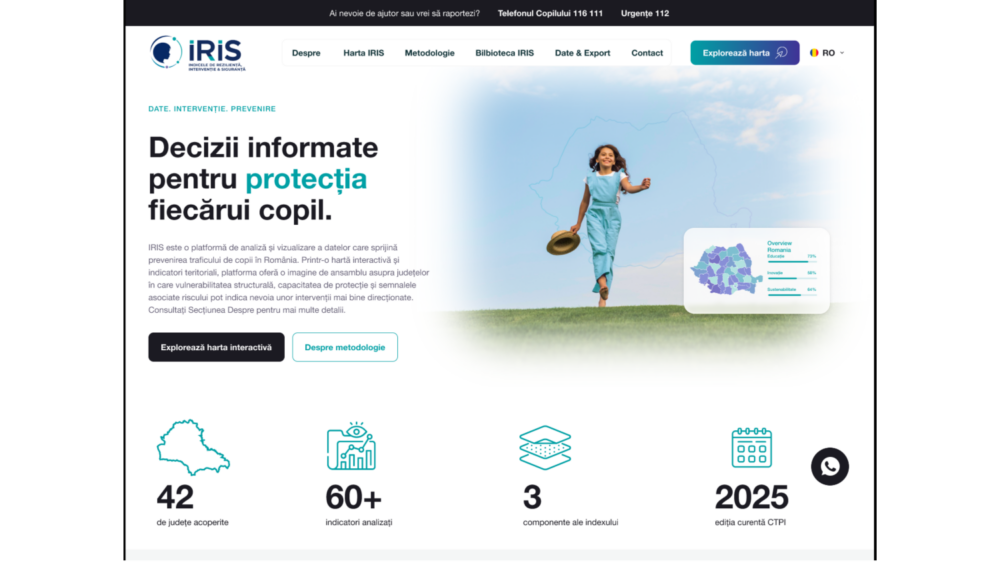
July 30th is World Day Against Trafficking in Persons, a moment that draws global attention to the urgent need for stronger prevention and protection. In Romania, the Child Protection Compact project — a partnership between the United States Government and the Romanian Government, funded by the U.S. Department of State and implemented by World Vision in collaboration with consortium partners — is advancing this effort through an innovative GIS Heatmap (an interactive mapping tool) conceived and developed by local partner, and Romanian anti-trafficking organization, eLiberare, in collaboration with consortium partners.
By bringing fragmented government data into a single analytical framework, the platform aims to help decision-makers better understand how trafficking vulnerability, prevalence, and the capacity of local protection systems intersect across the country at a county level—supporting more targeted prevention, more strategic allocation of resources, and stronger protection for children and communities.
Want to see the platform in development? Explore the current GIS Heatmap design in both desktop and mobile formats.
Bringing different dimensions of risk together
The GIS Heatmap examines three complementary dimensions: structural vulnerability, institutional resilience, and trafficking risk indicators. Together, they offer a broader picture of the conditions that may increase vulnerability to trafficking and the capacity of local systems to prevent and respond to exploitation.
More than 60 risk indicators were identified and collected during the platform’s development, with 43 currently available at county level. These indicators cover poverty and employment, school dropout, migration, child protection, victim profiles, exploitation patterns, prevention programs, social services, institutional staffing, and prior criminal justice responses (investigated and prosecuted).
Data has been provided by key Romanian public institutions, including the Ministry of Justice, the National Institute of Statistics, the National Authority for the Protection of Children’s Rights and Adoption, the Directorate for Investigating Organized Crime and Terrorism, the National Agency against Trafficking in Persons, and the Romanian Police.
The platform is being designed to help national and county-level government stakeholders view and compare county-level indicators, identify emerging patterns, and examine changes over time. This could provide a clearer picture of where vulnerabilities may coincide with gaps in local prevention and protection systems and response capacity.
From reported cases to smarter prevention
Official trafficking case data is essential, but it cannot provide a complete picture of vulnerability. A county may have relatively few identified cases while still facing structural conditions that could increase risk, such as poverty, school dropout, migration, or gaps in local services. Low case numbers may reflect limited identification and response capacities, as many cases may go unidentified.
By analyzing multiple dimensions together, the Heatmap can help identify areas where structural vulnerabilities may warrant proactive attention. This could support more targeted prevention programs, improved coordination between institutions, and longer-term monitoring of trends and investments.
The goal is to give decision-makers a stronger evidence base for understanding where vulnerabilities may be concentrated and where prevention and protection systems may need greater support.
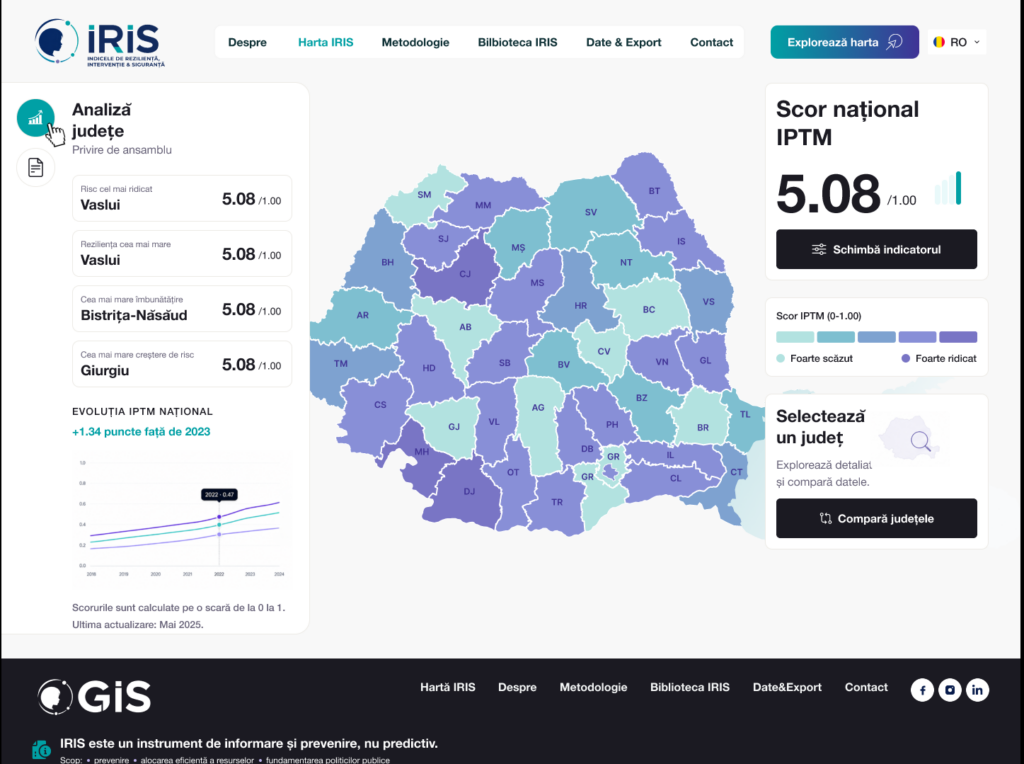
Mockup of the GIS Heatmap platform displaying how child protection risk and resilience scores could be visualized across Romania’s 42 counties. This image does not contain real data.
Built through consultation and designed for practical use
The Heatmap has been developed through ongoing consultation with seven Romanian public institutions that hold relevant data. These exchanges have helped identify and clarify available information while also revealing inconsistencies, limitations, and gaps in the current evidence base. Identifying what is missing is itself valuable — these gaps can highlight areas where future collection, reporting, and institutional monitoring need to be strengthened.
The methodology has also benefited from feedback from five international organizations and groups of technical experts with experience in trafficking prevention, technology, and data. Their input has helped test the relevance, ethical safeguards and practical application of the approach.
The platform has now moved beyond the conceptual stage. A substantial multisource dataset has been assembled, the methodology is being refined, a technical provider has been selected and initial interface mock-ups have been developed. As the work advances, continued attention to data quality, responsible interpretation, and the protection of sensitive information will remain essential.
Looking ahead, the GIS Heatmap is expected to be launched around October 18, coinciding with European Anti-Trafficking Day, marking an important step toward making the platform available as a practical tool for evidence-informed decision-making.
The long-term objective is for the GIS Heatmap to become a decision-support resource for strategic planning, resource allocation, and prevention policies at both national and county levels, equipping government stakeholders with the data and insights needed to strengthen anti-trafficking systems, make evidence-informed decisions, and sustainably target resources to areas of greatest need
On World Day Against Trafficking in Persons, this work reflects a simple but important principle: effective action depends not only on having data, but on connecting and using it responsibly and intelligently. When governments can better understand where risks are concentrated, where local systems need strengthening, and where critical information is still missing, they are better equipped to direct resources strategically and strengthen protection for children, families, and communities most vulnerable to trafficking.
Learn more about World Vision’s work to combat trafficking in persons.
