
Our Commitment to World-Class Evidence
Compelling evidence of impact starts with technically sound programs, co-created with communities, partners, and staff across local, national, and international contexts. We are data-driven, community-centered, and impact-focused — because people matter.
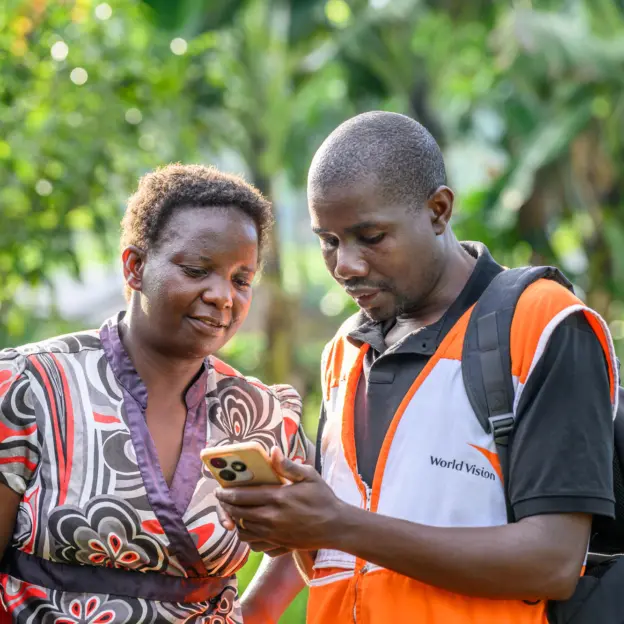
Our technical monitoring and evaluation (M&E) and research experts work hand-in-hand with local partners to ensure that program participants and their communities remain at the center of design, implementation, and learning.
Once collected, data is translated into insights that improve ongoing programs, guide future redesign, and help ensure accountability to our donors and the communities we serve.
What we do
World Vision U.S.’s Evidence and Learning team combines two complementary functions:
- Design, Monitoring, and Evaluation (DME)
- Research, Learning, and Analytics (RLA)
Together we:
- Strengthen programs through rigorous design and continuous monitoring
- Evaluate outcomes to understand what’s working, what’s not, and why.
- Conduct research that builds global knowledge on what transforms lives.
- Share insights with donors, governments, and communities for greater impact.
Our work improves programs, informs decisions, strengthens accountability, and inspires confidence among our donors.
How we do it
We use proven methods — tailored to each context — to build credible, actionable evidence. Our approach is rooted in key principles that include:
- Evidence-based design: We ground programs in proven solutions and contextual data.
- Monitoring for improvement: We use real-time data and feedback loops to adapt as we go, ensuring data quality through the life of a program.
- Adaptive management: Using evidence to make timely decisions, refine strategies, and respond to emerging needs.
- Rigorous evaluations: Both internal and third-party studies measure results. These include:
- Performance evaluations: Assess program achievements against planned targets.
- Impact evaluations: Compare participants to non-participants to isolate what changes are directly attributable to the program.
- Sustainability learning: Post-program evaluations explore what endures after programs end — and why.
- Evidence synthesis: We combine data across time, regions, or sectors to reveal broader trends and insights.
- Learning agendas: Identifying evidence gaps and setting priorities for research and reflection to focus our research on the most pressing questions.
- Community engagement: We ensure monitoring and evaluation reflects local voices, leadership, and priorities.
- Donor accountability: We ensure our donors — from individuals to institutions — see the impact of their contributions through rigorous, transparent evidence that clearly demonstrates outcomes and complies with grant requirements.
Who we work with
We partner with some of the world’s leading research and evaluation institutions, including:
- ABT Associates
- Baylor University
- EIDO Research
- Fuller Theological Seminary
- Harvard University
- International Food Policy Research Institute (IFPRI)
- Innovations for Poverty Action (IPA)
- Limestone Analytics
- RMIT University
- Tufts University
- Tulane University
- University of Illinois
- University of Nairobi
- University of North Carolina at Chapel Hill
We also work hand-in-hand with local communities, local private sector groups, and local and national governments to ensure local ownership and long-term viability.


Featured Research
This study examines how access to water, sanitation, and hygiene (WASH) services relates to women’s empowerment in Zambia and Honduras, using data from 3,434 h…
This study assessed whether empowerment from World Vision’s faith-based Empowered Worldview (EWV) approach persisted 3–5 years after delivery among smallholder…
This cross-sectional study analyzed endline data from 1,371 households in northern and southern Somalia participating in World Vision’s 2018–2019 Emergency Foo…
