
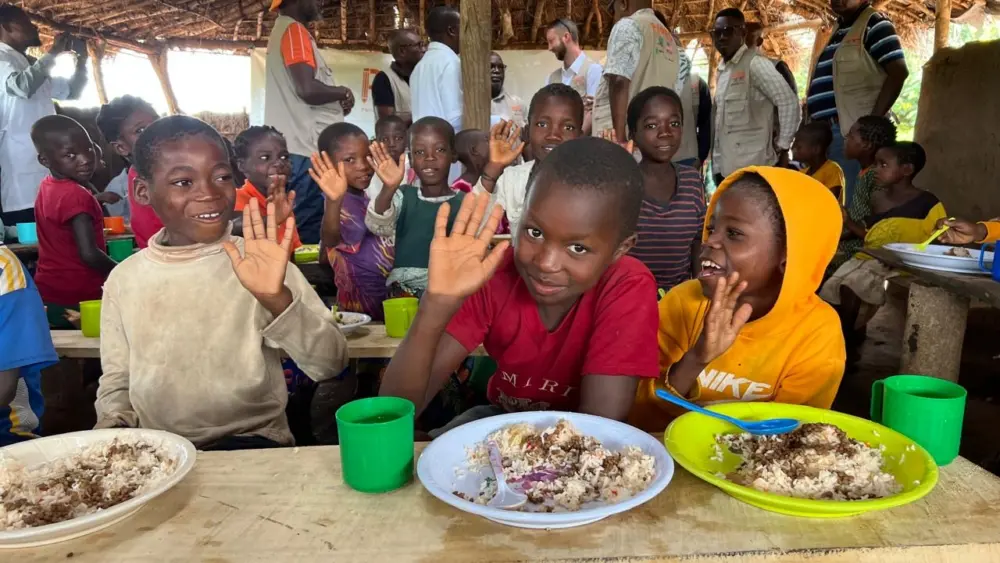
Harnessing school feeding and water security to build stronger, more inclusive food systems
The 2026 Norman E. Borlaug International Dialogue brings together leaders and experts working across agriculture, nutrition, food security, water, and global development. World Vision will contribute to conversations about how governments, partners, and communities can strengthen food systems, improve nutrition, and build resilience — from harnessing school feeding as a market platform to securing the water access that underpins agriculture and community well-being — through evidence, practical experience, and locally grounded solutions.
🎤 Join World Vision on the main stage
What If The Water Runs Out? Tuesday, October 20, 2 p.m. (Main stage)
World Vision U.S. President and CEO Edgar Sandoval will participate in a conversation on water and food systems. The discussion will address resilience, water purification and technology, community access, and the ways agriculture must adapt as water becomes less predictable.
🤝 Join World Vision’s side event
From Procurement to Policy: Unlocking the Food Systems Potential of School Feeding Wednesday, October 21, 7:30–8:30 a.m. (Room 313, 3rd Floor, Iowa Events Center)
What if one of the most powerful tools for shaping food systems and preventing hunger is already reaching millions of children every day?
Globally, 40% of the population in developing countries is under the age of 18. When national school feeding programs are strong, these millions of school-age children represent a powerful force for driving food systems change. Far more than a source of nutritious meals, school feeding programs can influence how food is produced, procured, marketed, and consumed well beyond the school gate.
This session will explore how governments can leverage school feeding policy to strengthen local and regional markets, expand opportunities for smallholder farmers and food enterprises, promote the production and consumption of diverse, nutritious foods, and build more resilient and inclusive food systems.
Through country experiences and practical lessons, panelists will examine how decisions on procurement, nutrition standards, financing, infrastructure, and institutional coordination can create benefits that extend far beyond school meals. The discussion will highlight how school feeding can serve as a strategic policy platform that simultaneously supports children’s nutrition and education while helping shape stronger, healthier, and more sustainable food systems.
Hosted by World Vision, with panelists from World Vision, the Alliance to End Hunger, World Food Programme, the International Food Policy Research Institute (IFPRI), and Global Communities.
📚 Explore World Vision’s school feeding resources
World Vision’s global school meals portfolio
Explore country profiles highlighting the reach and diversity of World Vision’s school meals programs, including examples from Angola, Cambodia, Mozambique, and other countries.
📄 Explore the global school meals country profiles
Integrated approaches to school meals
Learn how World Vision combines school meals with education, health and nutrition, local sourcing, livelihoods, water, sanitation and hygiene, child protection, and climate resilience.
Connecting farmer groups with school markets
Watch how farmer groups supported through the ECT-3 project in Mozambique strengthened their capacity to produce and market food, including through connections with local schools.
🎥 Watch the ECT-3 farmers group video
Connecting school meals, local markets, and community ownership in Cambodia
Explore how school feeding connects local producers and enterprises with school markets while supporting children’s nutrition and education. These resources highlight aquaculture market linkages and the roles of suppliers, school committees, parents, and government institutions in sustaining school meals.
🎥 Watch the Cambodia school feeding video
📄 Read Sustainable School Feeding through Aquaculture in Cambodia
📄 Read From Project Support to Local Ownership: Sustaining School Meals in Cambodia
Building sustainable school feeding systems in Mozambique
Explore how lessons from ECT III informed the design of PARES and continue to shape efforts to strengthen school feeding through local procurement, community ownership, and government engagement.
🎥 Watch the PARES school feeding video
📄 Explore the Mozambique PARES project summary
From production to consumption: strengthening food systems through school feeding in Angola
Explore how the ANGEL project uses school feeding as a platform to improve nutrition, support education, strengthen local procurement, build the capacity of farmers and communities, and advance sustainable food systems. See how these efforts connect food production, school meals, and community resilience while supporting Angola’s national school feeding priorities.
